FFWD – Salmon and Potatoes in a Jar

The cured, baked salmon, with the jarred potatoes in the background

I took the low road on last Friday’s recipe – I made the bonne idée version of the salmon, though I did follow through and put the potatoes into a jar. I don’t regret it, though. Cured and briefly roasted sockeye salmon is a lovely treat. Salty, but not enough to be off-putting, perfect for stirring into scrambled eggs or crumbling over salad greens. The potatoes make a great side for those eggs and if you spoon them over the greens before you add the salmon, no other dressing is needed.

Salmon, ready for baking

I love the slight crunch that’s left in the thin slices of uncooked carrot and onion that are added to the marinade, along with boiled new potatoes. Herbs and spices infuse everything with their flavours, especially after a couple of days. The onion loses its sharpness, which allows me to enjoy it much more.

I intend to try the salmon in a jar someday, but I’ll save it for a time when we’re picnicking with others. It seems like a dish to share. The potatoes, though, I’d gladly keep for myself.

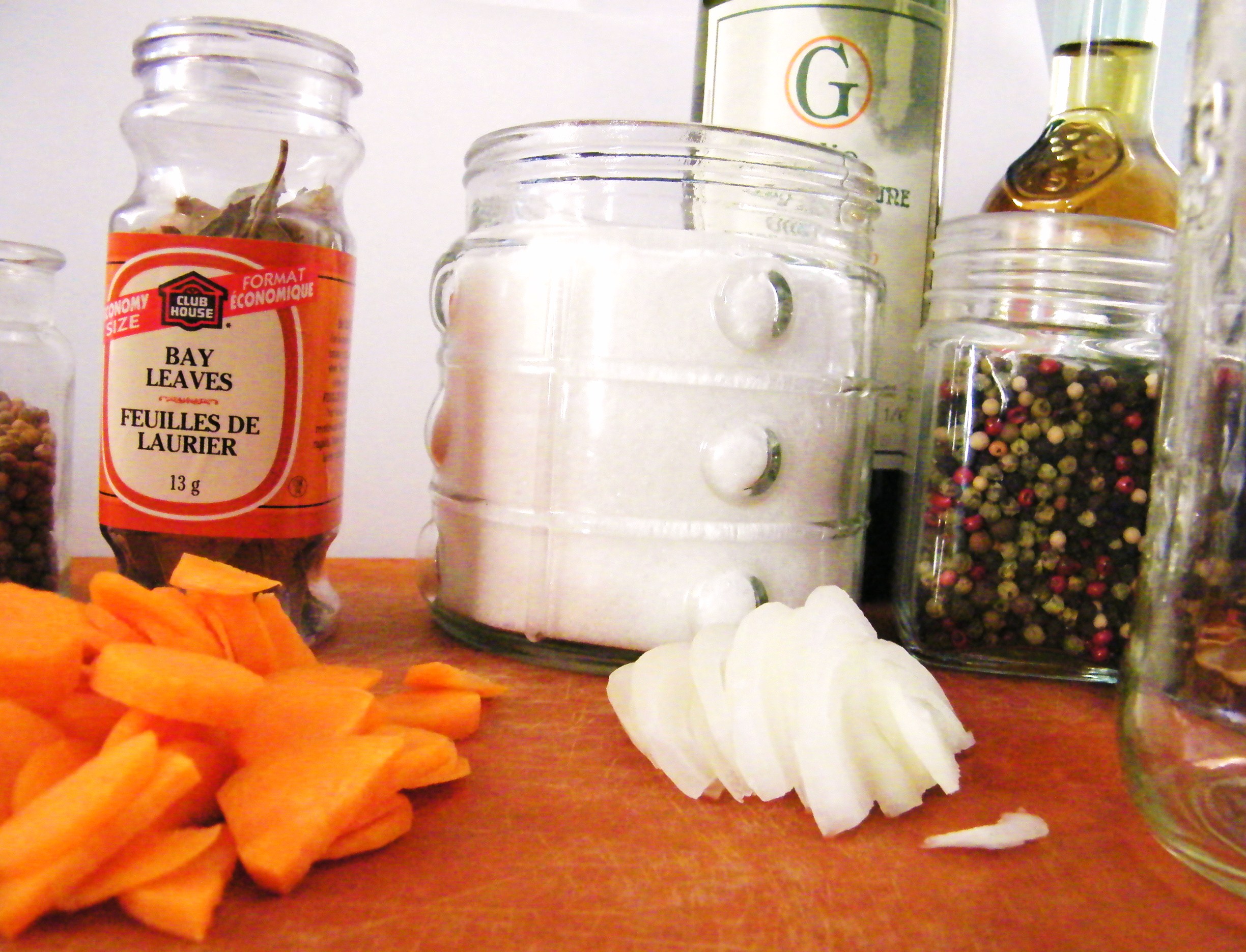
Ingredients for the potatoes in a jar

Tomorrow, I’ll be blogging on schedule for this week’s recipe, Eggplant Caviar.

You can find many other blogged descriptions of this week’s FFWD recipe here: Salmon and Potatoes in a Jar

FFWD – Slow-Roasted Tomatoes

Chopping tomatoes in the (extremely strong) afternoon light.

The lines between restaurant cooking and home cooking have been slowly blurring for a long time, now. Actually, it’s probably more accurate to say that they converge and diverge over time. Right now, we’re in the midst of a gourmet revival, which seems to happen every generation or so. I direct you to almost any cooking blog for further research. At the same time, there’s also been a revival of interest in home-cooking from a professional perspective. In my town, restaurants like Grub, Burgoo, and The Wallflower have made names for themselves presenting and reinventing comfort food. My brother, a chef, cites not only professionals as mentors, but also my mother. Of course, a professional chef can’t surpass your mother’s famous [insert specialty here] and there are few home cooks who can match the expertise and equipment available to chefs.

One of the fundamental things that separates the two is preparation…though perhaps I mean preparations. At home, the success of a dish is often based on seasoning and the care put into assembling and cooking the dish. An apple pie is the result of a gentle hand with pastry, judicious spicing of the filling and a careful eye on the oven. In a professional kitchen, the Mother sauces provide the springboard upon which a menu is built, but the same care is put into other ingredients. Especially at restaurants that make use of seasonal produce, it’s the preparation of ingredients that can transform a dish. It’s a step beyond what we usually do at home.

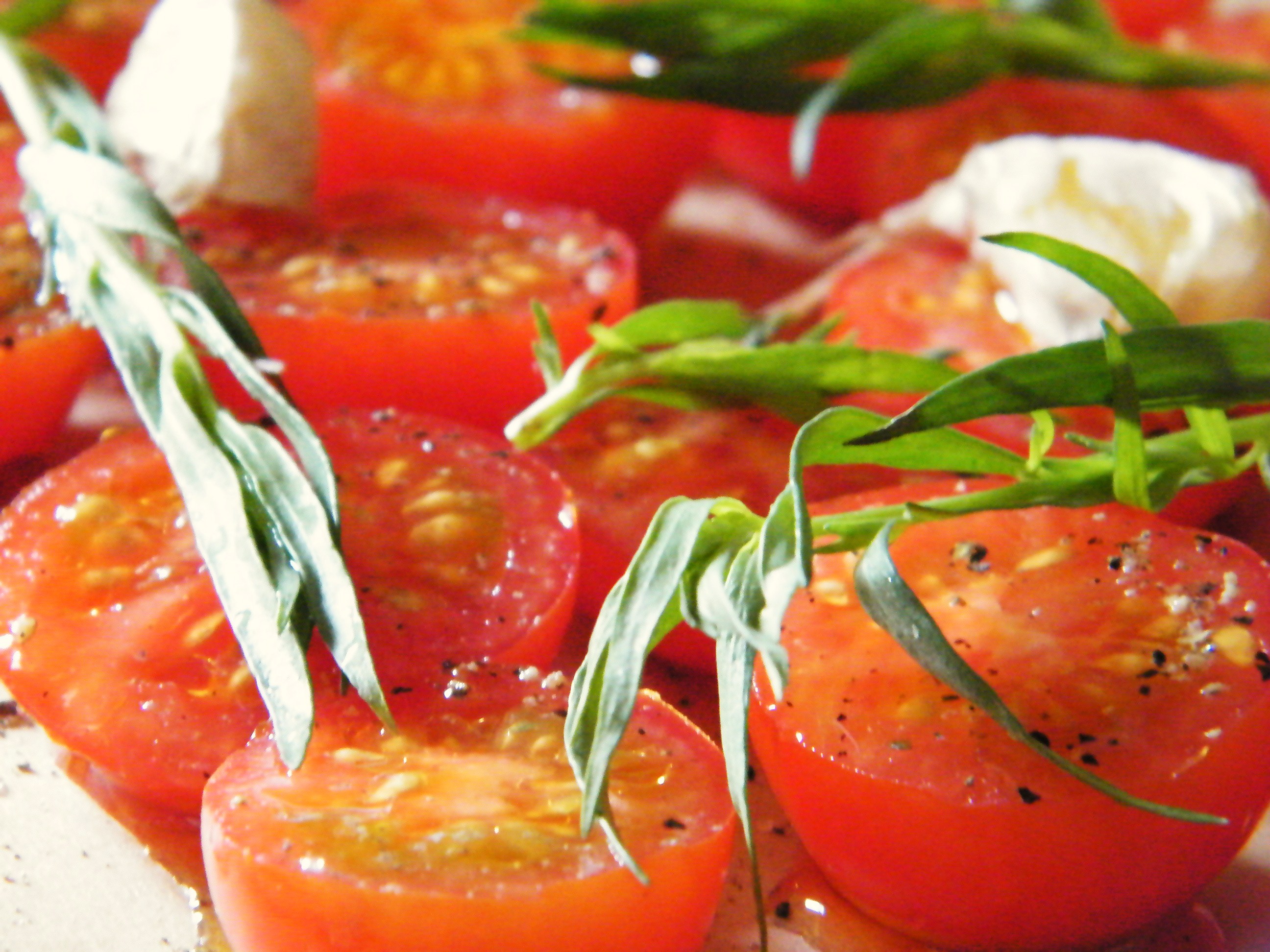
The tomatoes, seasoned with tarragon, garlic, coarse pepper and sea salt, ready to go into the oven.

This is the train of thought that I followed when reading this week’s French Friday recipe for slow-roasted tomatoes. It seems more like a preparation that would be found in a professional kitchen than a home cook’s staple. It should be a staple, though. Slow-roasting is a wonderful, hands-off process for a quiet day at home. It’s also an effective method for concentrating flavour. This summer, I’ve slow-roasted strawberries, rhubarb and now tomatoes. Tomorrow, I’m going to try cherries. I think they’ll be great as a tart filling. But, I digress.

Dorie’s slow-roasted tomatoes can be flavoured with garlic and herbs, or just a little salt and pepper. They can be used immediately or packed in olive oil to use over the course of a few weeks. They can be ground into a paste, added to a dish during cooking, or used as a garnish. It’s this versatility that reminds me of restaurants.

Save for a taste after they were finished, I haven’t used my tomatoes yet. I’ve packed them in olive oil and they’re waiting in the fridge, ready to bring my home cooking up a notch.

You can find many other blogged descriptions of this week’s FFWD recipe here: Slow-Roasted Tomatoes

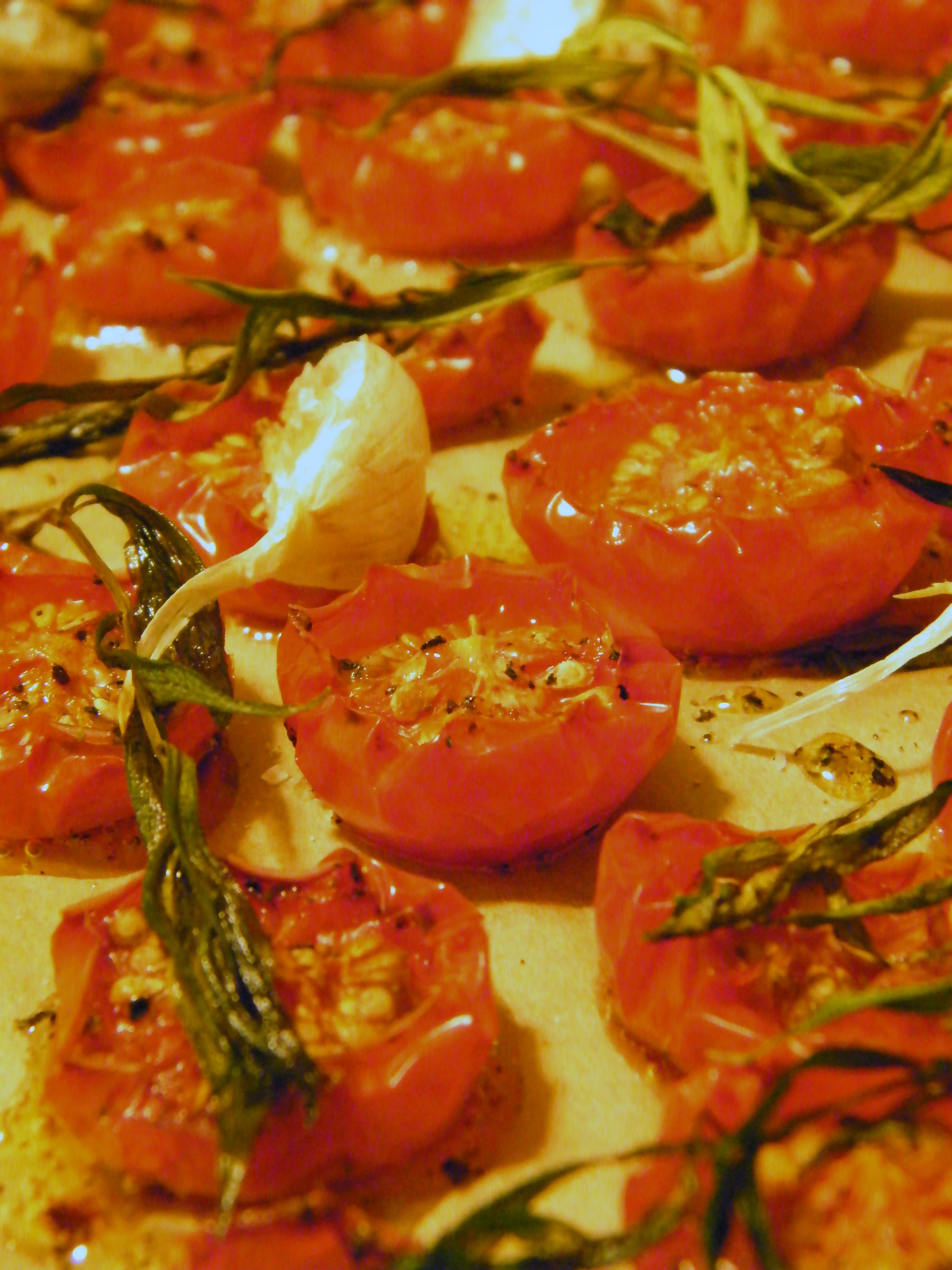
The tomatoes, roasted and cooling.

I’ve just realized today that I’m nearly at my 100th post and am only a few weeks away from my one-year-blogoversary. So, I’m trying to think up a little something to celebrate. As they say in advertising: Watch This Space.

A Tale of Two Crusts – A French Fridays Catch-Up

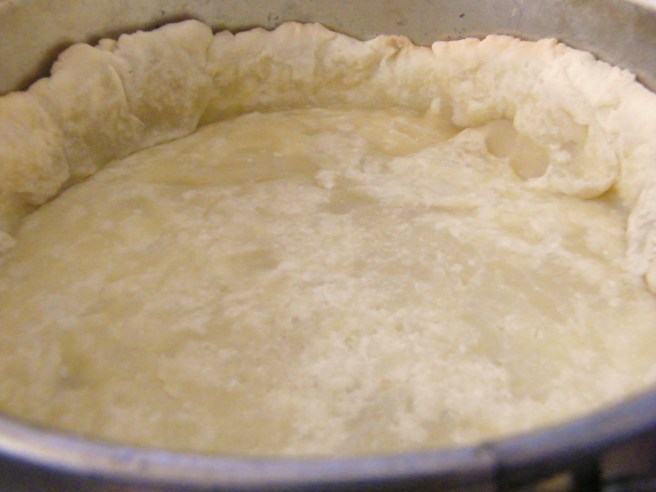
Par-baked tart dough crust, ready to be filled.

My post on this week’s recipe, Citrus-Berry Terrine, will have to wait until later this weekend. I’m still not fully up to standing for very long, but think I can manage it in the next day or two. After all, I don’t want to miss out on using local berries at the height of their goodness.

Instead, I’m going to do a catch up post on two of the recipes I missed out on when they were scheduled. Torteau de chèvre was one of the recipes I’d been looking forward to from the beginning of French Fridays, while Spinach and Bacon Quiche was a recipe that had escaped my notice at first.
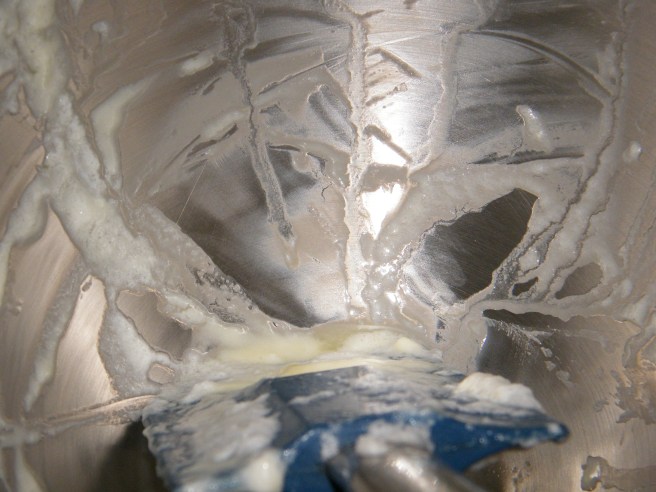
Scraping the last of the tourteau de chèvre filling.

What both of these recipes have in common is Dorie’s pâte brisée, or tart dough. This tart dough is not the cookie-like pâte sucrée, but one that has a similar structure and is suitable for both savoury and sweet fillings. I’ve managed to adapt it to gluten-free just by using my favourite gluten-free flour mix and reducing the quantity of flour by 1/4 cup. I wish g-f adaptation was always so easy.

As you can see from the photo at the top of this post, I don’t own a tart pan. So, I just press the dough into a springform pan to the height I need. It looks just fine when it’s filled and out of the oven, but I’m sure I’ll succumb to the temptation and purchase a tart pan at some point. What is a cooking club, after all, but a good excuse to buy more cooking equipment and exciting ingredients?
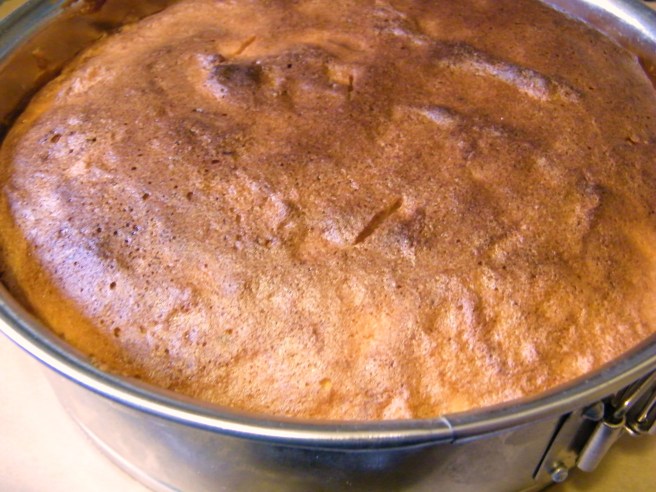
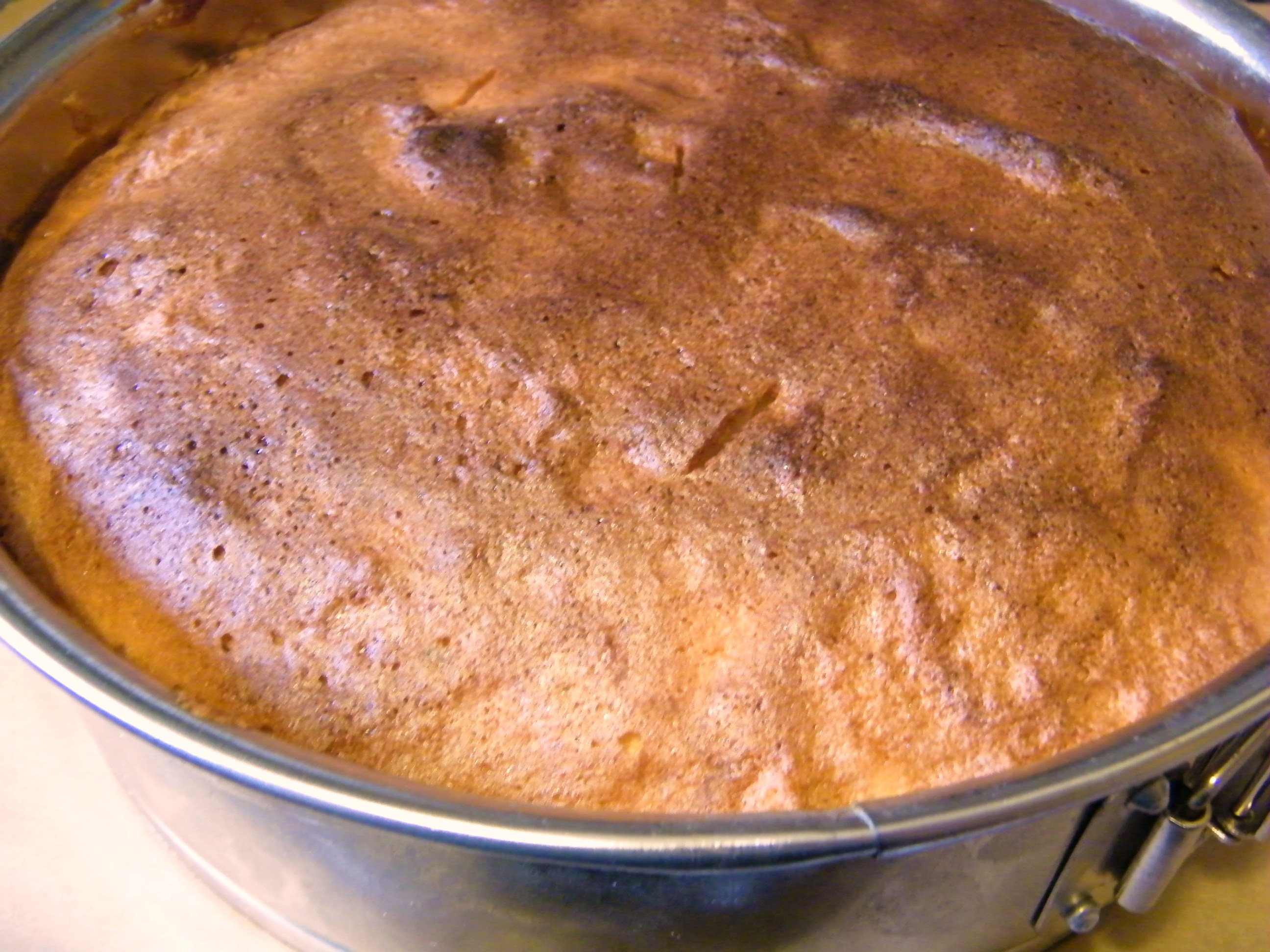
Torteau de chèvre, just out of the oven.

I’m not sure now why I didn’t get ’round to writing a post for torteau de chèvre, but I suspect it has something to do with how few of my photos turned out. I only ended up with two I liked. I’m slowly trying to break myself of the habit of photographing food after dark. At this time of year, that’s an easy task. In May, it was a little harder. No matter, the tourteau was beautiful under any light. Making the batter is a process of adding more and more air with every step. First, the egg whites are whipped to stiff peaks, then the rest of the ingredients are separately mixed into a light, smooth batter. Once the egg whites are folded into the goat cheese mixture, the batter is almost frothy. So, it’s a surprise that once it’s poured into the par-baked crust and baked, what emerges from the oven is more like a sponge cake than a cheesecake.

I just ate the slices out of hand, without any embellishment, but you could easily serve it with a fruit or a sauce. I love what Elaine did with hers, combining it with another French Fridays assignment.

Whisking the quiche filling.

My partner wasn’t a fan of the torteau de chèvre, but he loved the spinach and bacon quiche. In fact, this quiche sent me off into a quiche baking spree. Now that I know he likes it, it’s going to be something I make monthly. It’s great for light dinners and even better for packed lunches. This particular quiche is quite hearty, which is a departure from the dish’s 1980s reputation as a lightweight, fussy meal.
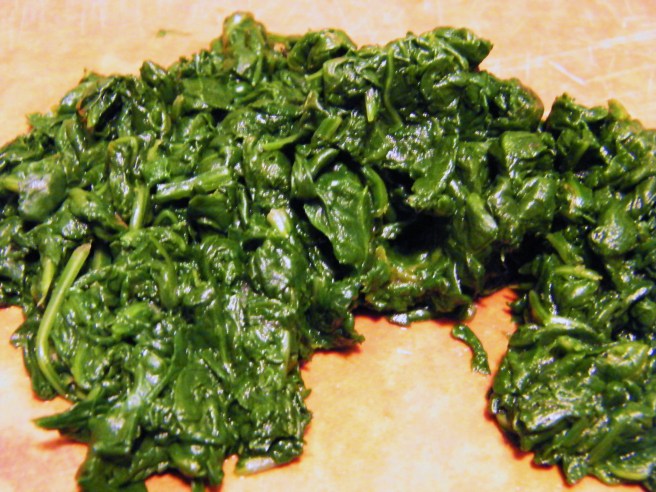
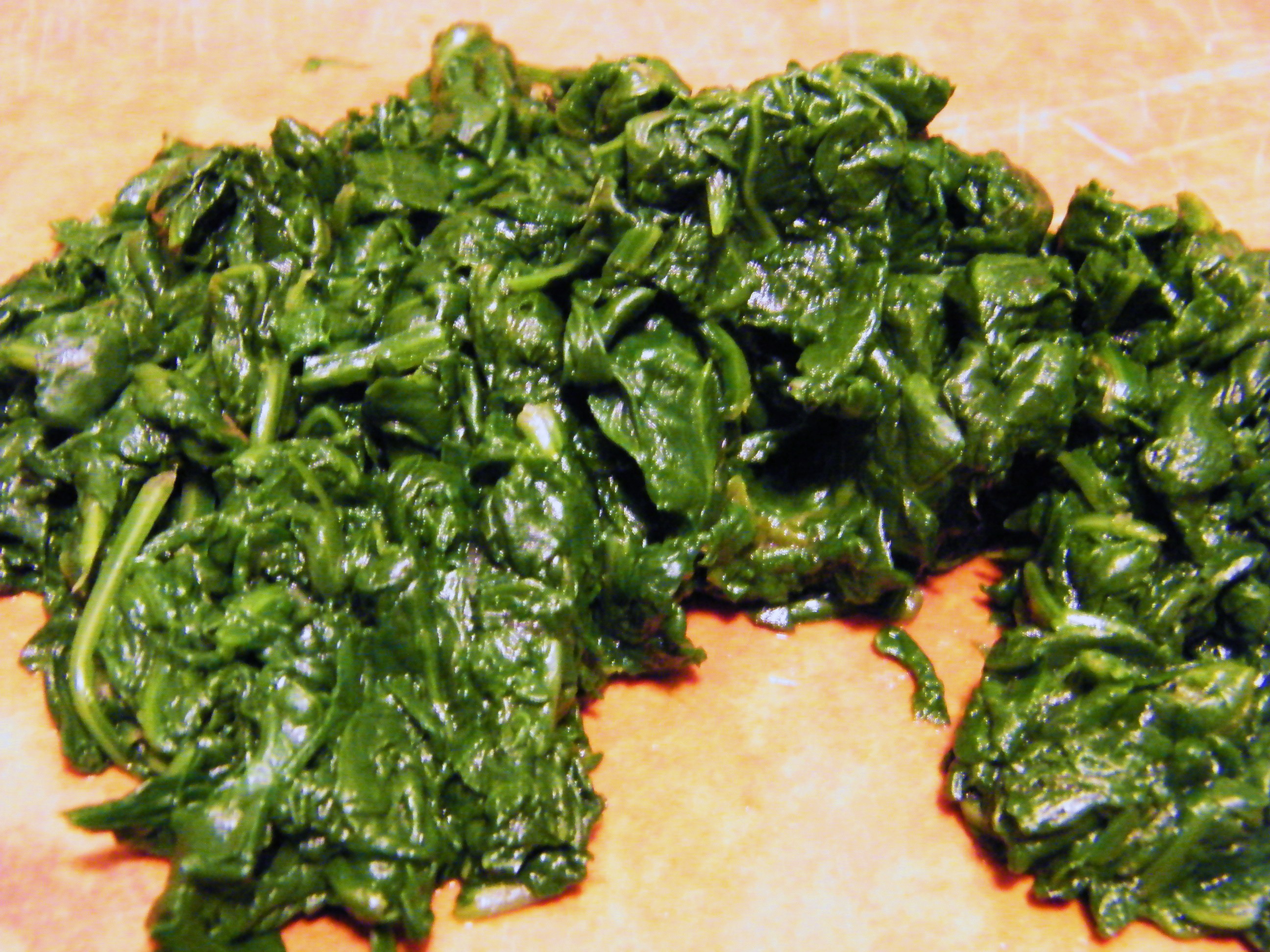
Chopped spinach, ready to go into the quiche.

I didn’t add any salt to the filling, as I knew the bacon and Parmesan would make it quite salty enough for us. It’s not something that I’d serve too regularly, as the eggs, heavy cream, cheese and bacon militate against heart health, but it’s a nice treat. It’s also something that could easily be adapted with lower-fat milk. I haven’t done it yet, but I’m planning on making a vegetarian version of this that’s a little more Mediterranean, inspired by Betsy, whose beet green quiche will also be on the menu, once I harvest the beets in my garden.

I’ve been on a quest for a good, easy gluten-free pie crust for a while now, but I’ve begun to feel that all I really need to do is to use this tart dough instead. It has a different taste and texture than pie crust, but everyone who has had the g-f version has loved it. I think I’m going to adapt my thinking around pies and stick with the dough that works. I have plenty of opportunities to make conventional pies and the crust recipe that’s been handed down in my family serves me well for those. Best of both worlds, I’d say.

A close up of the quiche, just out of the oven.

You can find many other blogged descriptions of these recipes here: Torteau de Chèvre and Spinach and Bacon Quiche

FFWD – Coconut-Lemongrass-Braised Pork

My parents live in a rural(ish) area of the Fraser Valley. There is a tiny downtown, a vestige of the village that was swallowed up by the municipality in which they live. They’re also twenty minutes away from suburbia in two directions, so they have access to everything they might want, including gourmet ingredients. What their area lacks, though, is reliable access to less usual ingredients at the last minute. It makes me realize that I’m spoiled. If I’m missing an ingredient, I can walk down the street, right up until around nine in the evening, and be almost guaranteed to find what I need. What I don’t have is the beautiful setting they live in. I also haven’t developed my mother’s instinct for planning ahead.

A closer look at the completed dish.

Knowing that I was making this week’s dish at my parents’ place should have caused me to take a look at the list of ingredients, then place a phone call to my mother to see what she had on hand. If I’d done that, I might have packed up the whole coriander and the cardamom pods in my pantry and run to the store for some fresh lemongrass. Instead, I blithely congratulated myself for remembering to pack the cookbook and headed out to the farm. When it finally came time to make a shopping list, my lack of forethought caused a scavenger hunt that amped up my (car-fueled) carbon footprint more than I’d like to say.

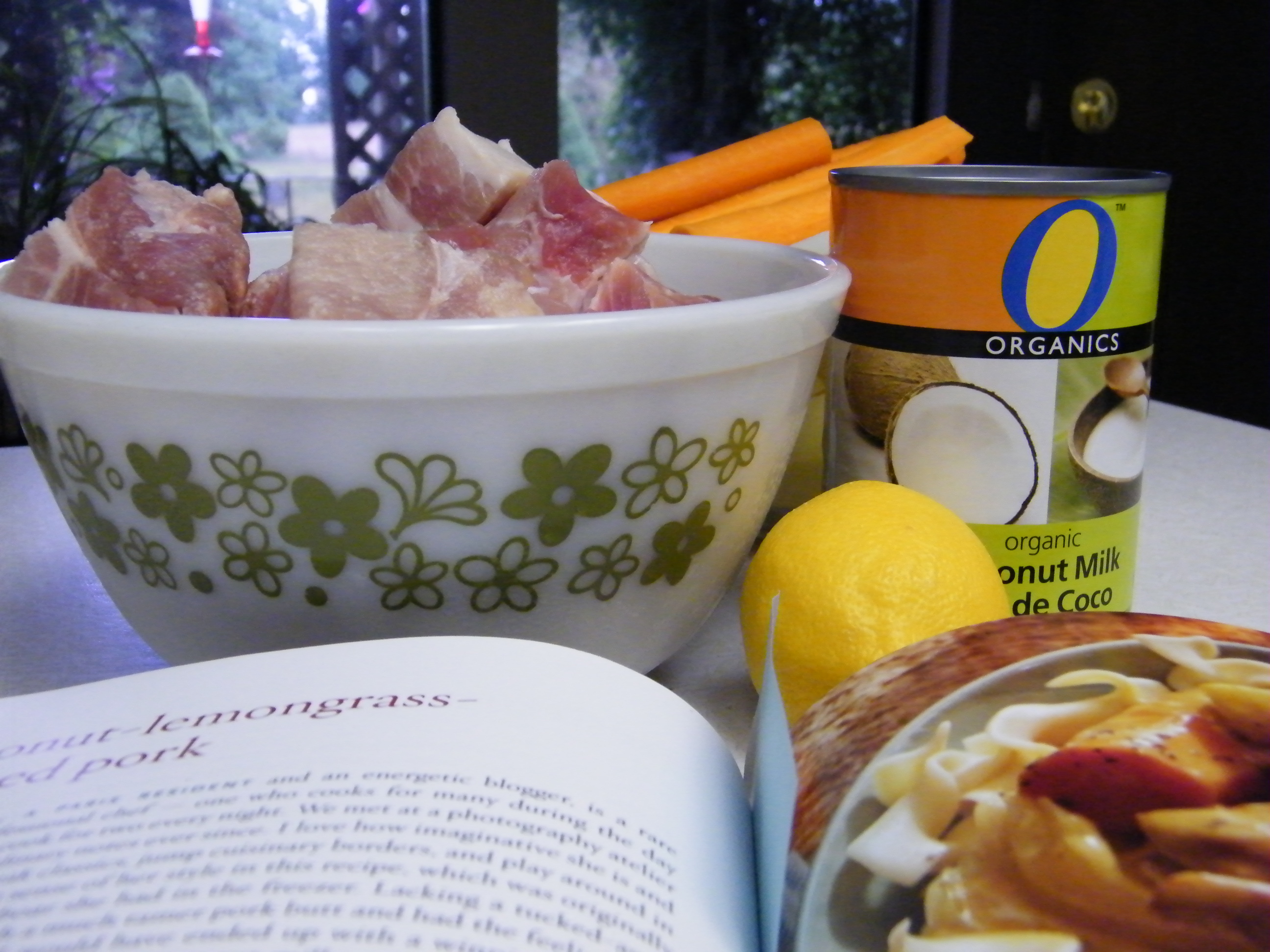
Ingredients at the ready, behind a cookbook laid open on the counter.

My mother has ground coriander and cardamom in her spice cupboard, but I thought I would be able to find whole versions when we went out for the rest of the ingredients.Two supermarkets and a specialty store later, I had managed to find everything but the cardamom and lemongrass. As I was being told there was no lemongrass by the third produce clerk of the day, another customer tapped my elbow. She told me she got frozen lemongrass from a little store downtown and that they might have cardamom pods, too.

Pork chunks, ready for browning.

Off we went. The store was packed full of all sorts of produce, spices and ingredients that you couldn’t find on the shelves of the local supermarkets – even mangosteen, which I rarely see around my neighbourhood. I enlisted the aid of the clerk, but she couldn’t find any cardamom at all. She thought she was completely out of lemongrass, too, until she remembered that there was some in a package of fresh ingredients for Tom Yum soup. More than enough lemongrass for my recipe, with enough left to try the soup mix another time. As I was paying, I mentioned how difficult it was to find what I needed to make a mildly Thai-influenced dish. “Not in this town,” was her response.

Browned pork, mixed with toasted spices.

Well, my parents’ farm has its own attractions. They occasionally raise a few pigs, which keeps the whole family in pork for quite some time. They are coming to the end of their latest stock of pork, but we found some pork chops that substituted nicely for the pork butt suggested in the recipe. I took out the bones with a filleting knife and the thick chops cut easily into 1-2 inch chunks. Our late summer meant that there weren’t yet any root vegetables ready from the garden, but I got some nice carrots, potatoes and onions from the local co-op.

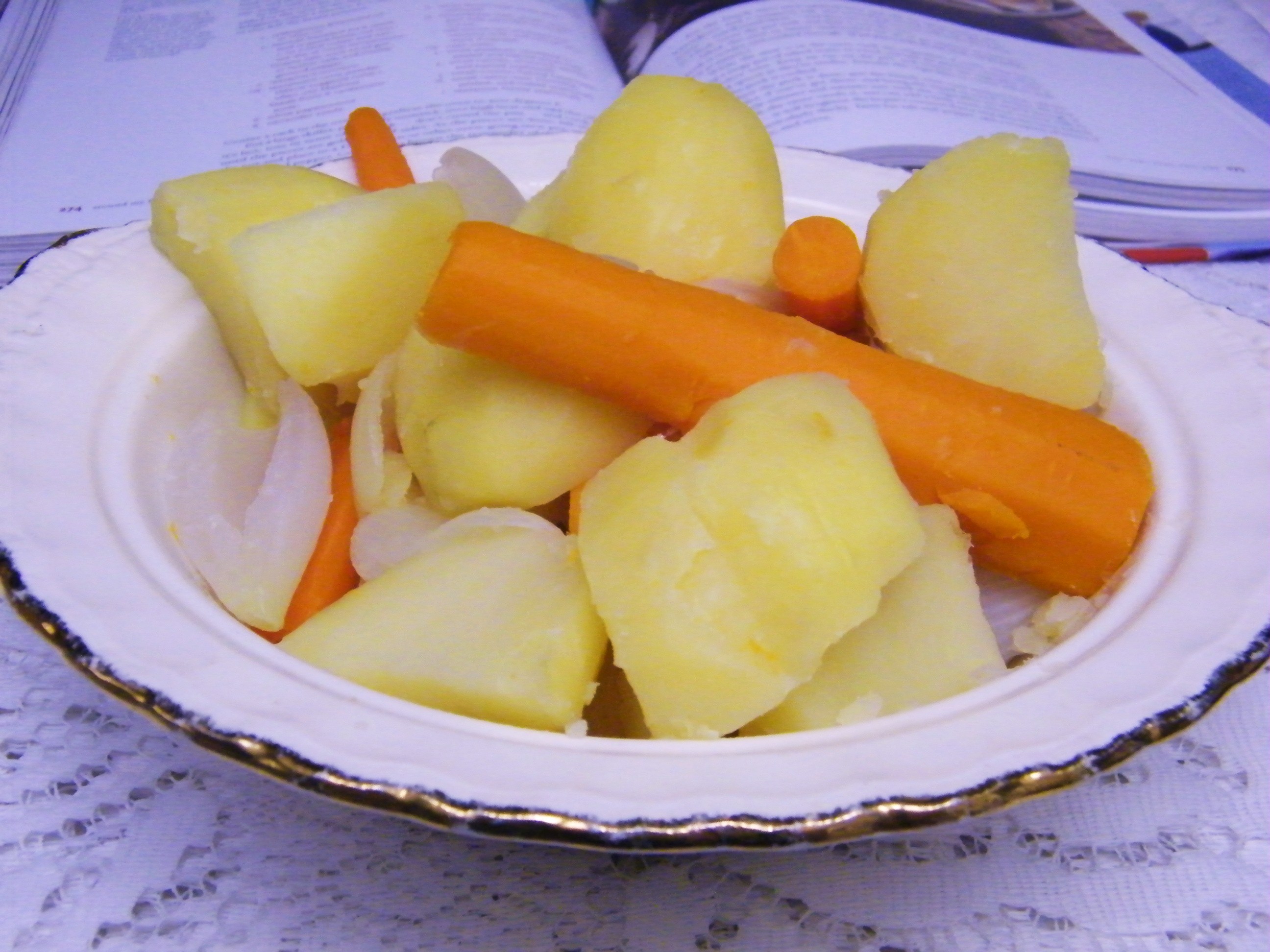
The cooked carrots, onions and potatoes arranged in a pretty dish, with a cookbook in the background.

After browning the meat, toasting the spices and adding the coconut milk, the kitchen was aromatic. Which made it hard to wait the more than half-hour it took to braise the stew. I kept busy, cooking the vegetables and finishing last week’s Cold Melon-Berry Soup, which we had as an appetizer while we waited for the stew to finish. Though the suggestions for serving this pork dish include pasta or rice, we served it just as it was. The vegetables provided enough of an anchor for the pork and its thin sauce. The stew can be finished with a touch of honey, but I neglected to add it. It didn’t matter, the flavours of the stew worked very well without it.

The completed dish, yellow with tumeric, in front of a cookbook.

I’m back home now, experiencing the best of both worlds, with some of my parents’ farm-raised meat in the freezer and all the ingredients I need just down the street.

You can find many other blogged descriptions of this week’s FFWD recipe here: Coconut-Lemongrass-Braised Pork

FFWD – Cold Melon-Berry Soup

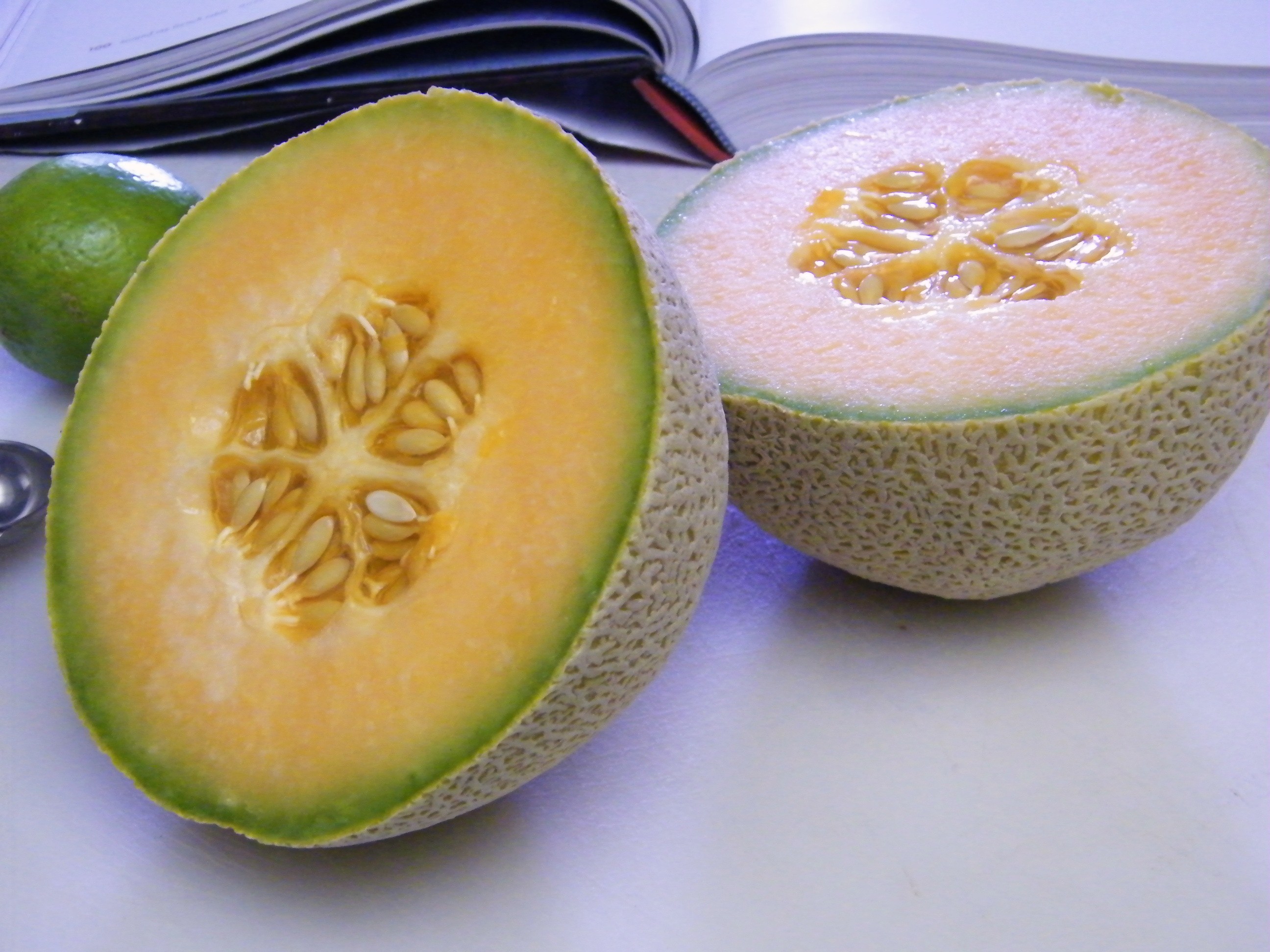
Sliced cantaloupe, with a cookbook, a lime and a measuring spoon visible in the background.

It took me half a cantaloupe to get the hang of making melon balls. They aren’t something that’s ever shown up on the menu chez moi, but I’ve only recently begun to appreciate melons. Melon wedges on a fruit tray, yes. Proscuitto wrapped around a slice of melon, certainly. But in my mind, melon balls are fare for a 1960’s country club buffet, piled in pyramids atop shaved ice in a silver dish. Or a cut glass dish on a silver salver. Something like that.

This probably influenced my thinking when I made this week’s melon-berry soup. I kept imagining it presented as though for a wedding supper or an awards banquet. I settled on some pretty etched glasses. A nod to the elegance I’d imagined, with the practicality required of a dish served in the living room. I was making next week’s Coconut Lemongrass-Braised Pork for dinner and thought that this soup would make a nice prelude to the curried sweetness of the stew.

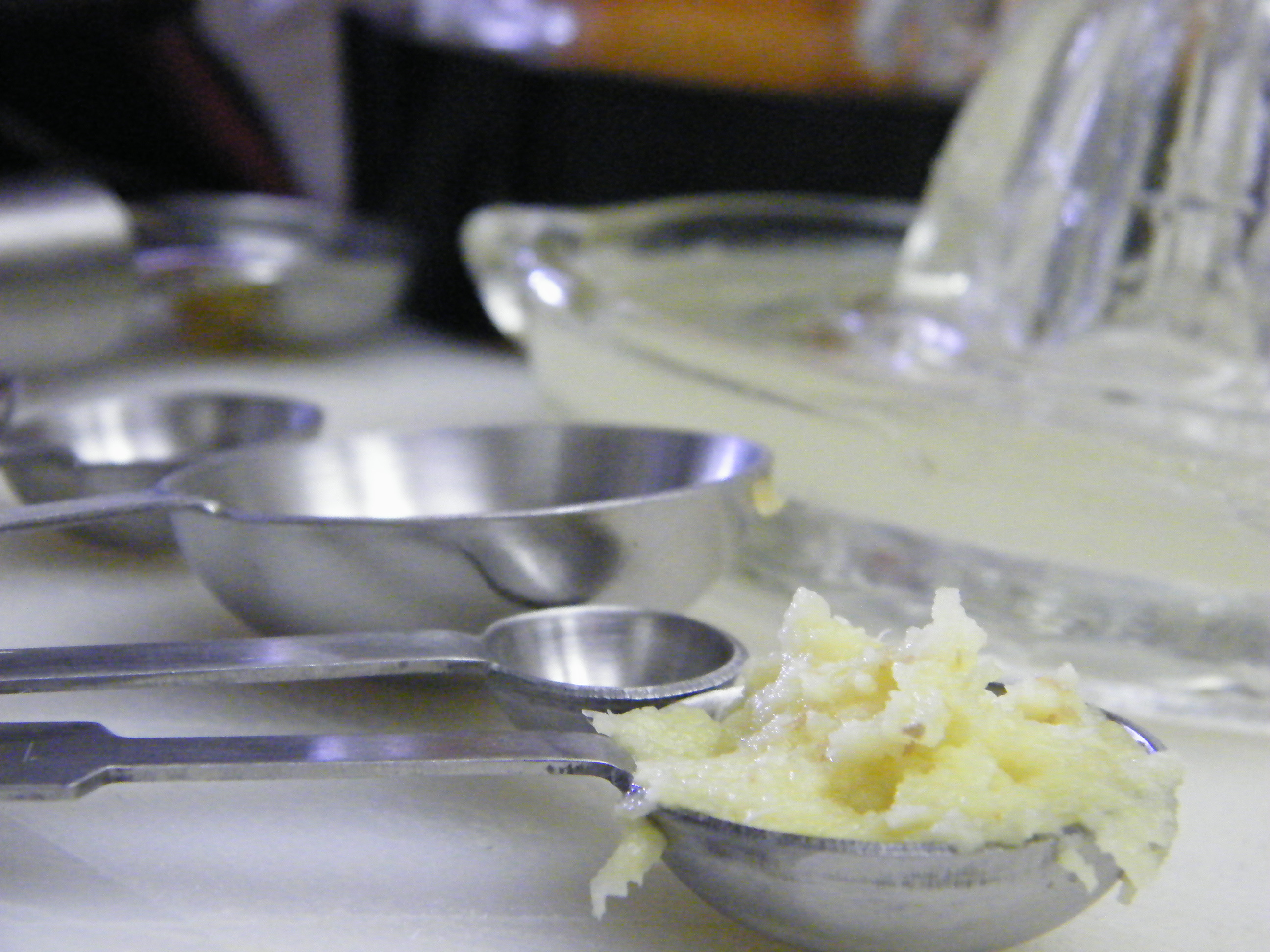
A teaspoon full of ginger, with the rest of the set in view, along with a glass juicer full of lime juice and the bottom of the blender full of melon.

The soup is simply pureed cantaloupe mixed with lime juice and grated ginger, then seasoned with a little salt. After the soup, melon balls and strawberries have chilled for a few hours, the dish is assembled and topped with a sprig of mint. You may add a tablespoon of sweet wine if you like, though I didn’t this time. I think the only thing I’d add to this is a good grinding of pepper. I think that would contrast well with the sweet-tartness of the rest of the dish.

I was at my parents’ house and gave my father his soup while I took photos of the other portions. My mother was playing food stylist/photographer’s assistant, bringing out many of her lovely, eclectic dishes for me to try and then holding up a white piece of card to make the most of the evening light. My Dad came into the kitchen to tell us that he liked the soup so much he’d gladly eat the rest. That’s an excellent endorsement, in my estimation.

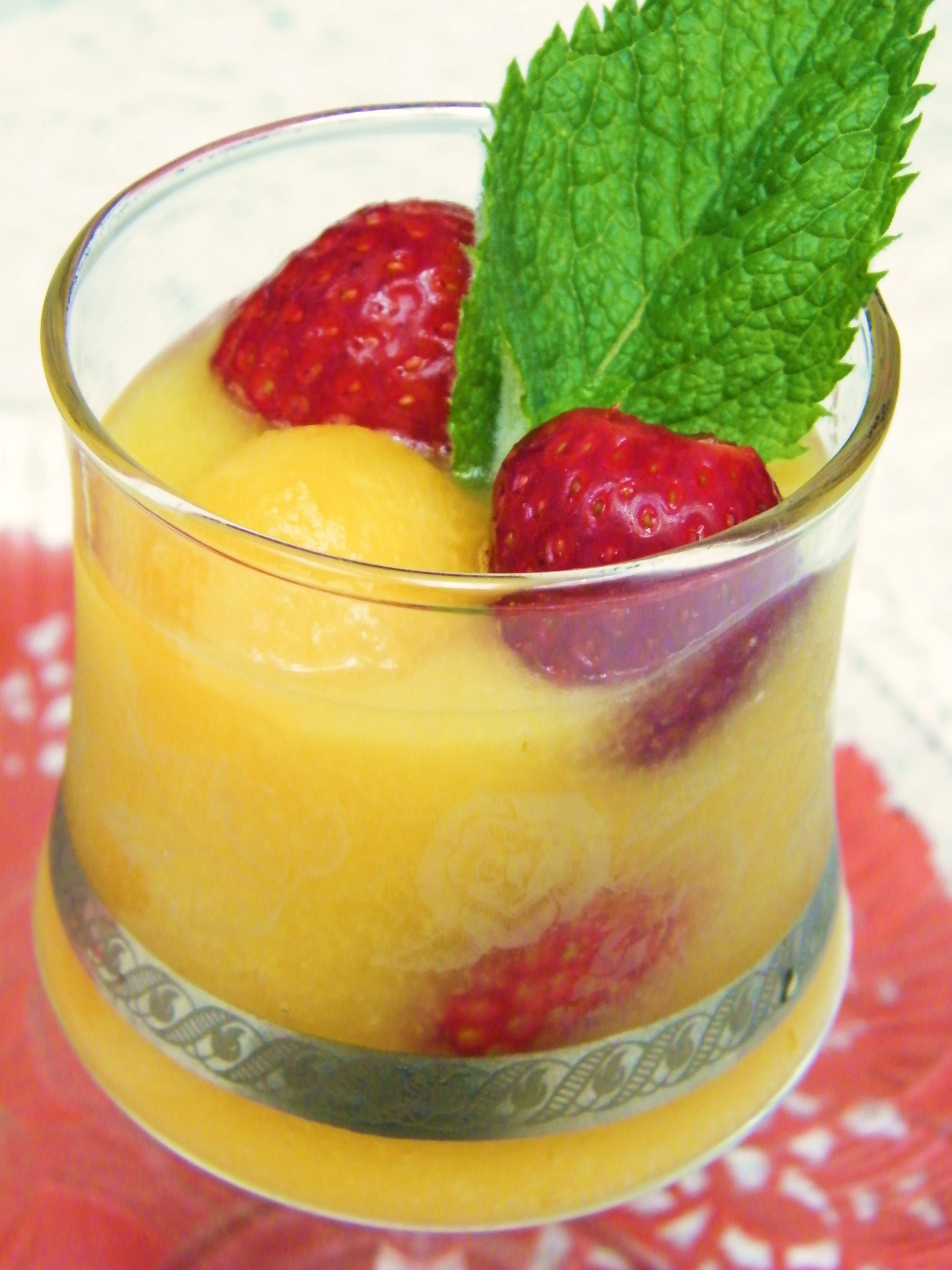
An etched wine glass full of melon soup, with melon balls and strawberries and a sprig of mint. Everything sits on a tray atop a red doily on a white lace tablecloth.

I think there are lots of jumping off points for this recipe: ice pops, cocktails, granitas – just make sure you include the melon balls. They’re the best part.

You can find many other blogged descriptions of this week’s FFWD recipe here: Cold Melon-Berry Soup

FFWD – Salmon and Tomatoes en Papillote

The salmon, topped with lemon slices and a basil leaf, ready to go into the oven.

I love using the en Papillote method of cooking. It’s our favourite way to cook fish and it also works really well for chicken (though for chicken I open up the package near the end of the cooking time so that it browns a little). Vary the liquid, the herbs and seasonings, add some fruit or vegetables – use whatever you have on hand that complements the protein you’re cooking. Or, go vegetarian and oven-steam summer squash or zucchini.

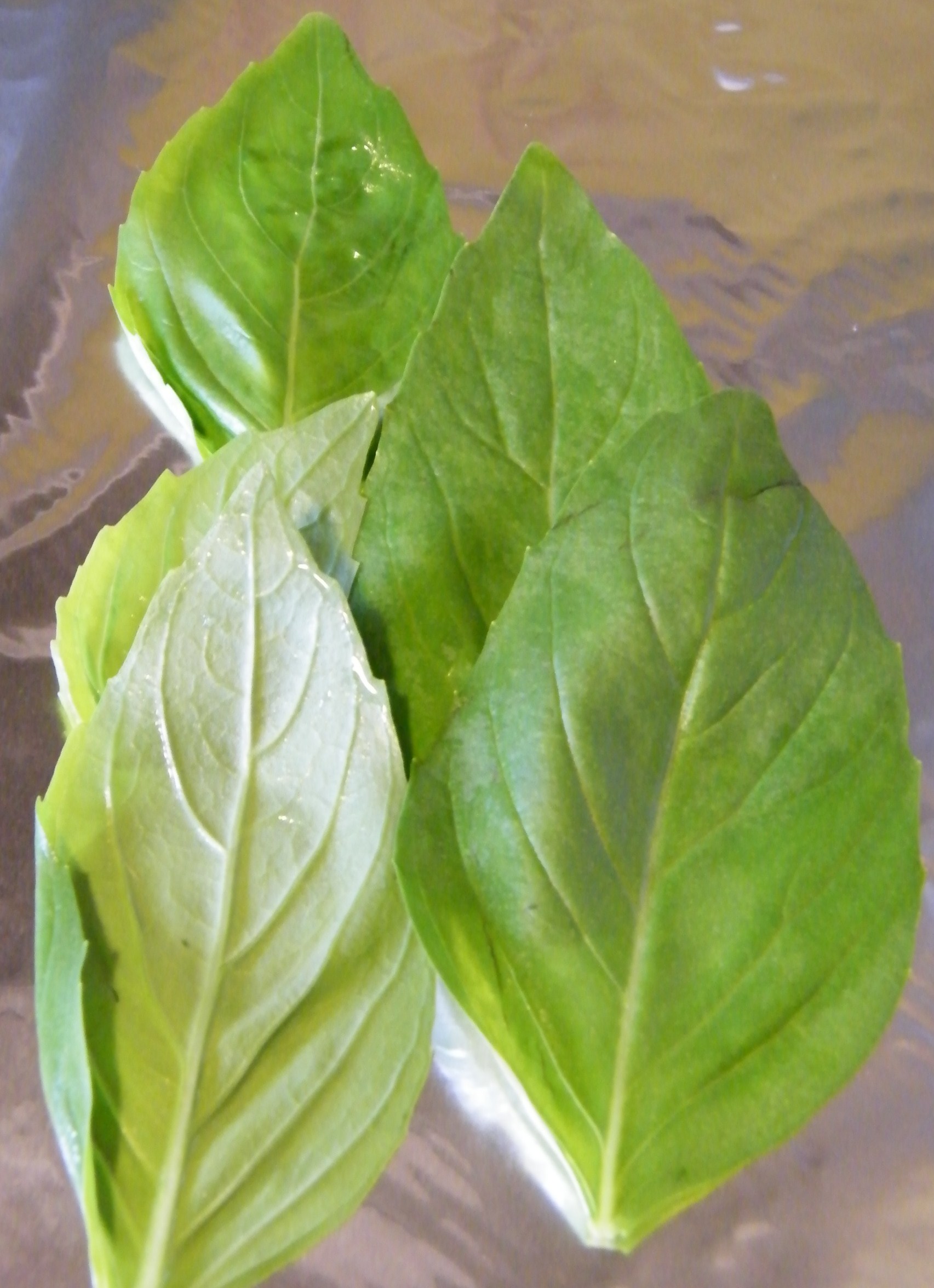
A bed of whole basil leaves for the salmon to rest on.

I have to admit that the flavour and tenderness that this method brings aren’t actually my favourite part of cooking en Papillote. It’s the clean up. I hate doing dishes and oven roasting can mean a lot more time in front of the sink than I wish to spend. There’s no scrubbing with en Papillote. And that always gets my vote.

That’s not to say that the result isn’t a big selling point in itself. The steam that builds up in the package infuses what you’re cooking with the flavours of the seasonings, while making it extremely tender. The liquid can even be used to make a nice pan sauce.

The salmon, just out of the oven and still resting on tin foil.

This week’s French Fridays recipe has all of these qualities, but it’s the way that the dish is constructed that makes it special. The ingredients are layered so that when it’s served, the dish looks elegant enough for a dinner party. The flavours of whole basil leaves, thick slabs of salmon, lemon slices and chopped scallions make it worthy of company, too. I used dried thyme, but sprigs of rosemary or thyme are called for in the recipe and would add nicely to the presentation.

The salmon, with the grape tomatoes in the background and roasted potatoes in the foreground.

This meal is good enough that I wouldn’t even mind cleaning up afterward.

You can find many other blogged descriptions of this week’s FFWD recipe here: Salmon and Tomatoes en Papillote

FFWD – Chunky Beets and Icy Red Onions

The dressed beets are yellow and white striped than rather than beet-coloured.

I’ve never understood why beets are on the no go list for so many people. They show up on the plate in so many different ways, they’re good through all four seasons, and they’re sweet and earthy without being too assertive. I hated pickles growing up, but my mother’s pickled beets were the exception. The only thing that can spoil borscht is too much vinegar. How many vegetables are good steamed, boiled, roasted or raw? You can even make cake with them.

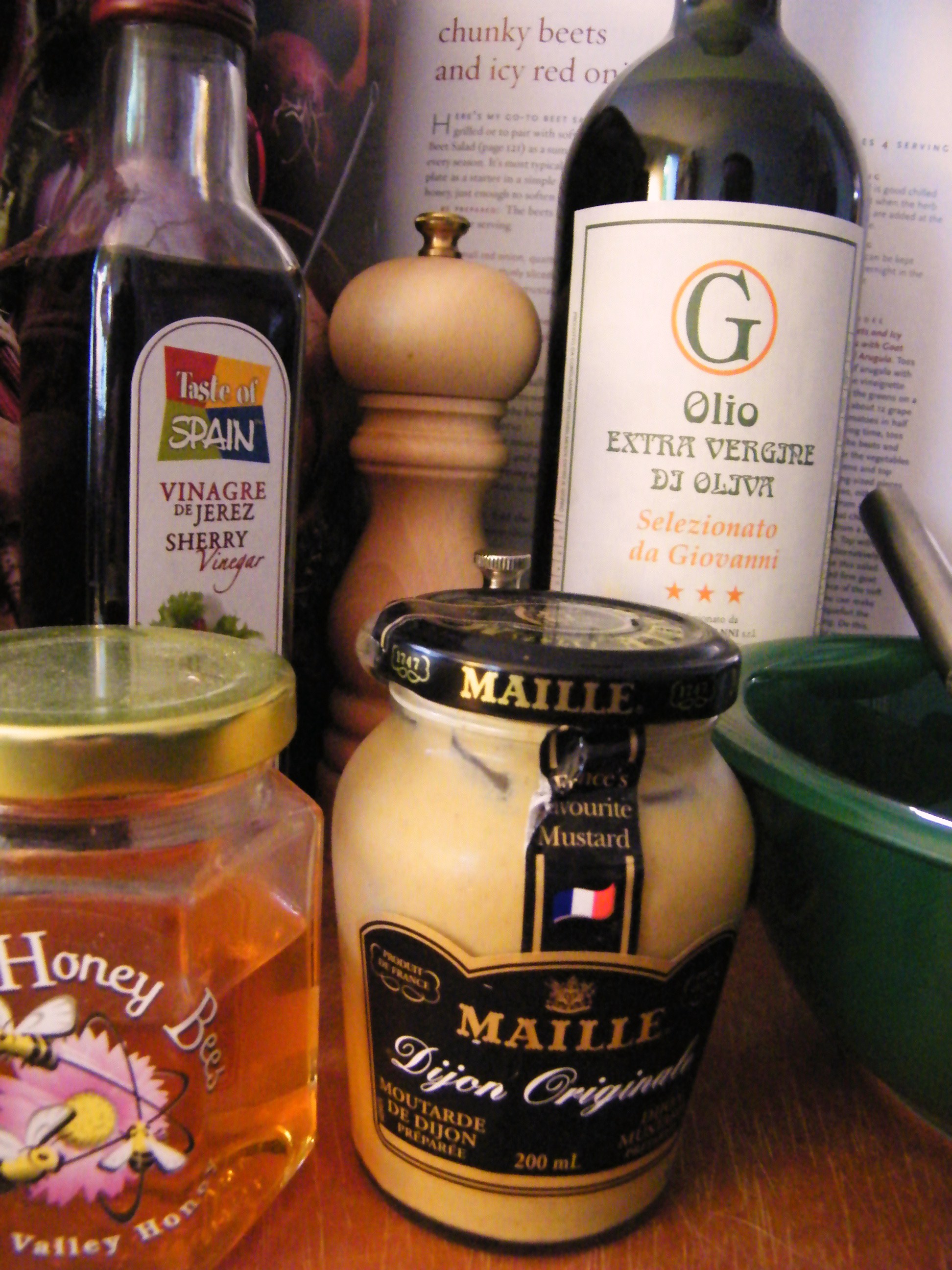
Ingredients for the vinaigrette.

Raw onions, however, give me pause. A little of those go a long way for me. I’ve even been known to discreetly slide thick rings of raw onion from sandwiches. I like them best when they’re chopped finely and used sparingly. The inclusion of raw onions in this week’s French Fridays recipe didn’t pose a problem for me, because they are thinly sliced and soaked in cold water to get the worst of the bite out. Then, they’re plunged into ice water until it’s time to sprinkle them on the salad.

Slivers of onion and ice cubes floating in water.

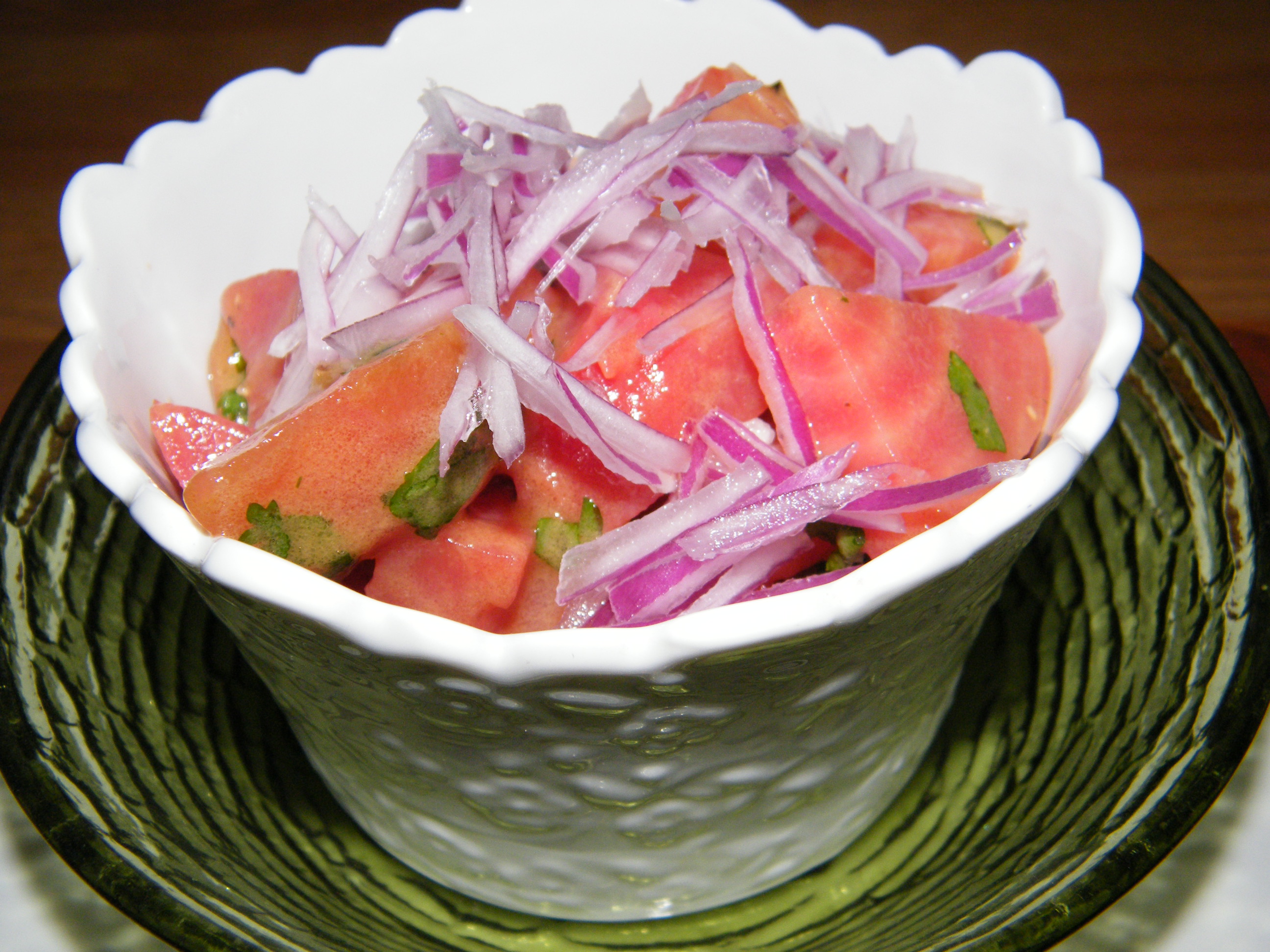
The salad itself is made of cooked, diced beets in a herbed honey-mustard vinagrette. I roasted some heirloom beets, striped to match the red onion, and substituted Italian parsley for the fresh oregano. The tamed onions make a nice, crunchy contrast to the roasted beets. This salad can be dressed up (as in Trevor’s version) or dressed down – I served mine with Dubliner/thyme scrambled eggs.

The completed salad in a fluted white bowl sitting in a green glass dish.

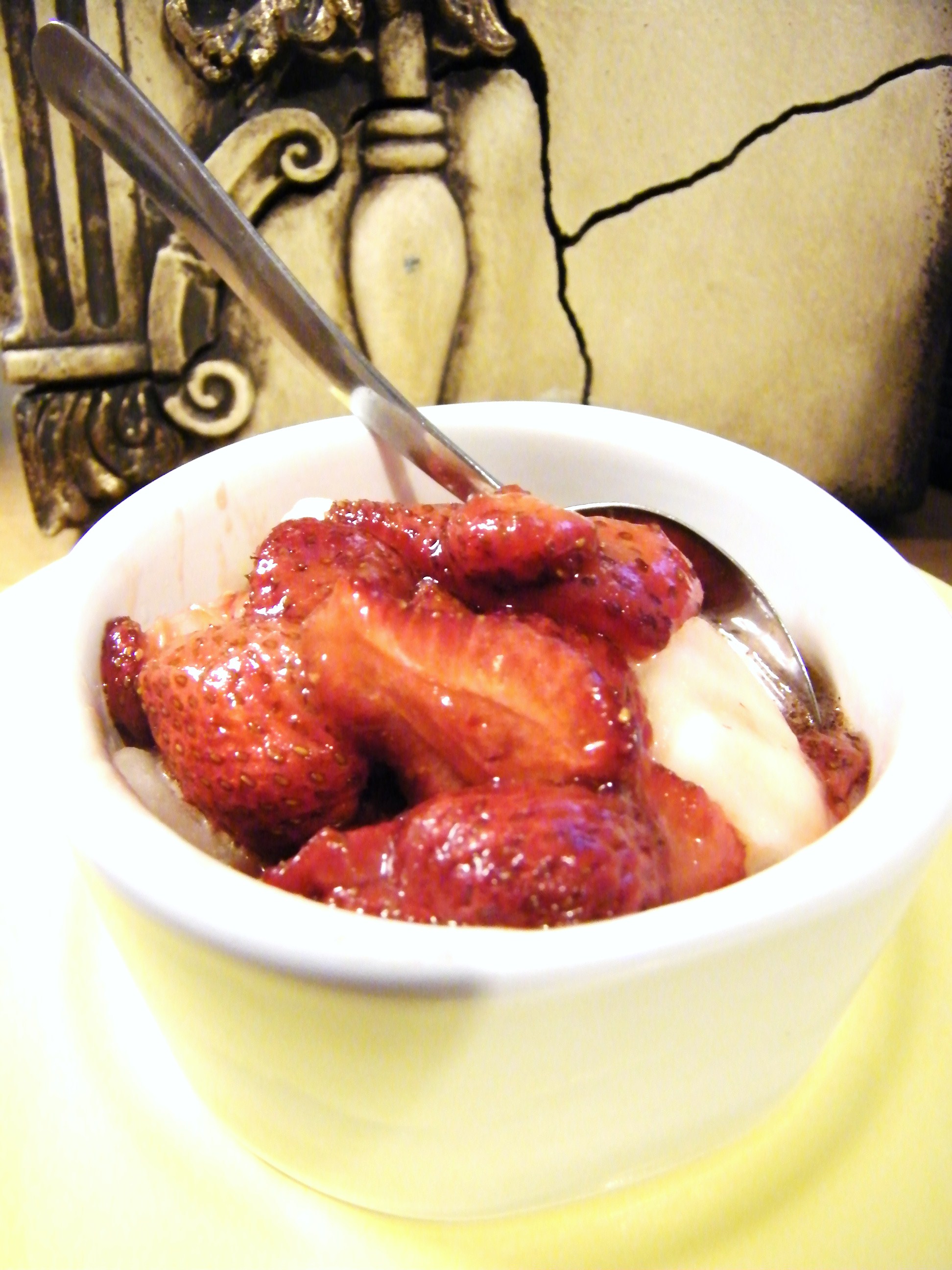
For dessert, I roasted strawberries using Heidi Swanson’s method and served them over lemon sorbet. I substituted cognac for the port, but that didn’t seem to diminish the goodness.

The roasted strawberries over lemon sorbet in a small, squared dish in front of a romanesque tile.

You can find many other blogged descriptions of this week’s FFWD recipe here: Chunky Beets and Icy Red Onions

FFWD – Mozzarella, Tomato and Strawberry Salad

Raindrops suspended from stems and flowers.

Torrential rain and summer salad aren’t natural companions. This afternoon, while the rain was pounding on the rooftops as loudly as hail, my mind was on quiche, soup and stew. Luckily, I’d already gotten all the ingredients for this week’s recipe, or I might have been guilty of yet another late post. I would have bought entirely different ingredients had I gone shopping today. By early evening, though, the sun was shining and salad became a reasonable dinner option.

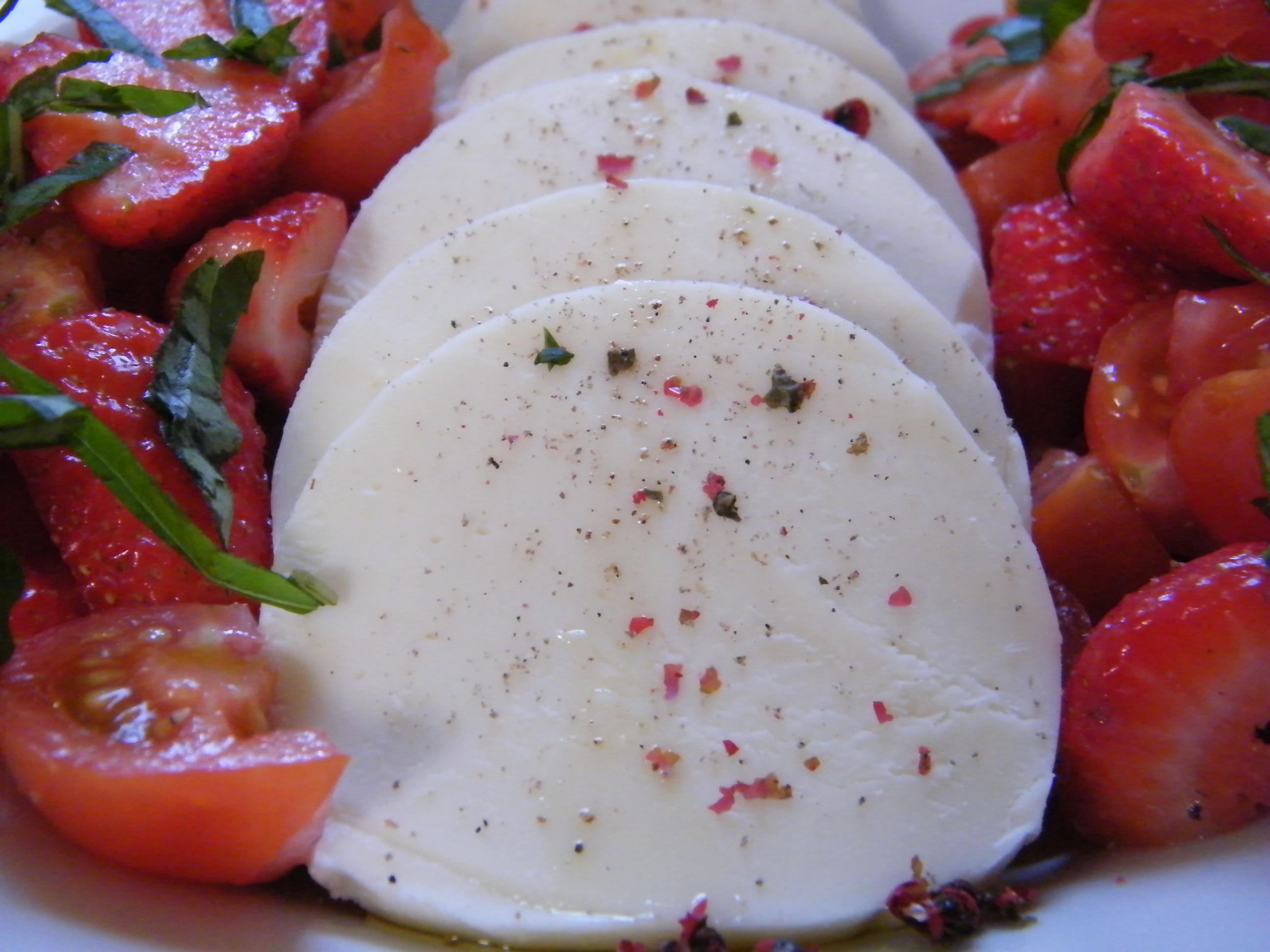
The sliced mozzarella, drizzled with oil and sprinkled with crushed pink peppercorns. Flanked on either side by mixed, sliced strawberries and tomatoes, garnished with shredded basil.

Purchasing the ingredients is the hardest part of this recipe. The salad is thrown together quickly, just before serving. Slice the mozzarella, then plate it. Slice and mix the strawberries with the tomatoes. Shred the fresh basil. The rest is just seasoning and drizzling some good olive oil. Add some balsamic to the fruit if you think it needs it and then garnish the mozzarella with crushed pink peppercorns.

Close up of the salad, focusing on a piece of basil atop sliced strawberries and cherry tomatoes. The slices of mozzarella are in the background.

Just as goat cheese and strawberries work together, tomatoes and strawberries are naturally compatible. I didn’t need to use balsamic, as the fruit had a good balance of sweet and acid without it. This worked well with the creaminess of the mozzarella and the tang of the basil. It’s been a cool, wet summer so far and we’ve been waiting a long time for strawberries. This salad was a perfect way to use the first local berries I’ve gotten this season.

This shot emphasizes the sliced mozzarella, drizzled with olive oil and with crushed peppercorns scatterd across them.

You can find many other blogged descriptions of this week’s FFWD recipe here: Mozzarella, Tomato and Strawberry Salad

FFWD – Roasted Rhubarb

Rhubarb in a field of sugar, with a partly zested lemon and (unsurprisingly) a zester.

It’s not the complicated recipes that evoke sensory memories for me, though I have plenty of other memories about those dishes. My mother’s French Onion soup is inextricably linked with Hayley Mills and The Moon-Spinners, because she once made it for us on a Mother and daughters movie night. Coq au Vin and Angel Food Cake bring to mind special occasions with Tante Leona, my mother’s aunt. Pâte de Cochon and tourtière mean Christmas. But these are associative memories, not strongly sensory.

The memories that transport me to particular periods of my life, rather than specific events, are triggered by simple aromas. Caramelizing sugar brings me back to early childhood, my mother making sucre à la crème on the stovetop. Roasting garlic and lemon are associated with my university years, when my idea of sophisticated home cuisine was 40 Cloves of Garlic Chicken. Rhubarb cooking down is the scent of early summer, reminding me of the building excitement as the school year neared its end. Rhubarb found its way into puffs, crisps and pies, but one of the first things my mother always did with it was to cook some down on the stove with sugar. It would often end up served over ice cream, usually on a hot June day.

Partly roasted rhubard sitting in a melted sugar bath.

We’ve not had many hot days this month, but this afternoon I evoked the memory of warm days with this week’s French Fridays recipe. Instead of cooking it down slowly on the stove, though, this recipe calls for chunks of rhubarb to be tossed with sugar and freshly grated lemon zest (I added a pinch of cinnamon, too) and then roasted in the oven. This method requires almost no attention – no frequent stirring and temperature checks and leaves the pieces of rhubarb soft, infused with the flavour of the sugar. Cooking rhubarb on the stovetop breaks down its fibres, incorporating the sugar syrup, but this method leaves the rhubarb intact, surrounded by a sugary sauce. It’s a lovely variation and just as good with ice cream as the original.

Roasted rhubarb, still warm and melting the ice cream it's accompanying.

What are some of the things that trigger sensory memories for you? Scents, sounds, colours? I’d love to hear.

You can find many other blogged descriptions of this week’s FFWD recipe here: Roasted Rhubarb

FFWD – Cola and Jam Spareribs

Spices, cola and jam.

Ribs and summer weather are a good fit. They bring up thoughts of potato salad, corn on the cob and lemonade. Since summer hasn’t exactly started here, it’s good that ribs are also a good match for sports. The Canucks [Seriously, WordPress, you don’t recognize the word Canucks?] are in the Stanley Cup finals and the whole city is in thrall to its televisions…with some notable exceptions. I’m sure they’ll be commenting to that effect on this post.

Heating the jam with the orange juice.

I’m a fair weather hockey fan. Bring me to a game and I’ll be watching every play. Otherwise, I don’t follow it until the playoffs. Even then, I only pay enough attention to make sure I don’t miss anything exciting. (The Canucks in the finals – exciting.) My family despairs of me. I was raised in a hockey-loving clan. My grandfather cheered for the Canadiens and some of my earliest memories are of three generations of my family crowded around the television in my grandparents’ living room. The decibel level was impressive. I was already a suspect fan; my favourite part of the broadcast was Peter Puck.

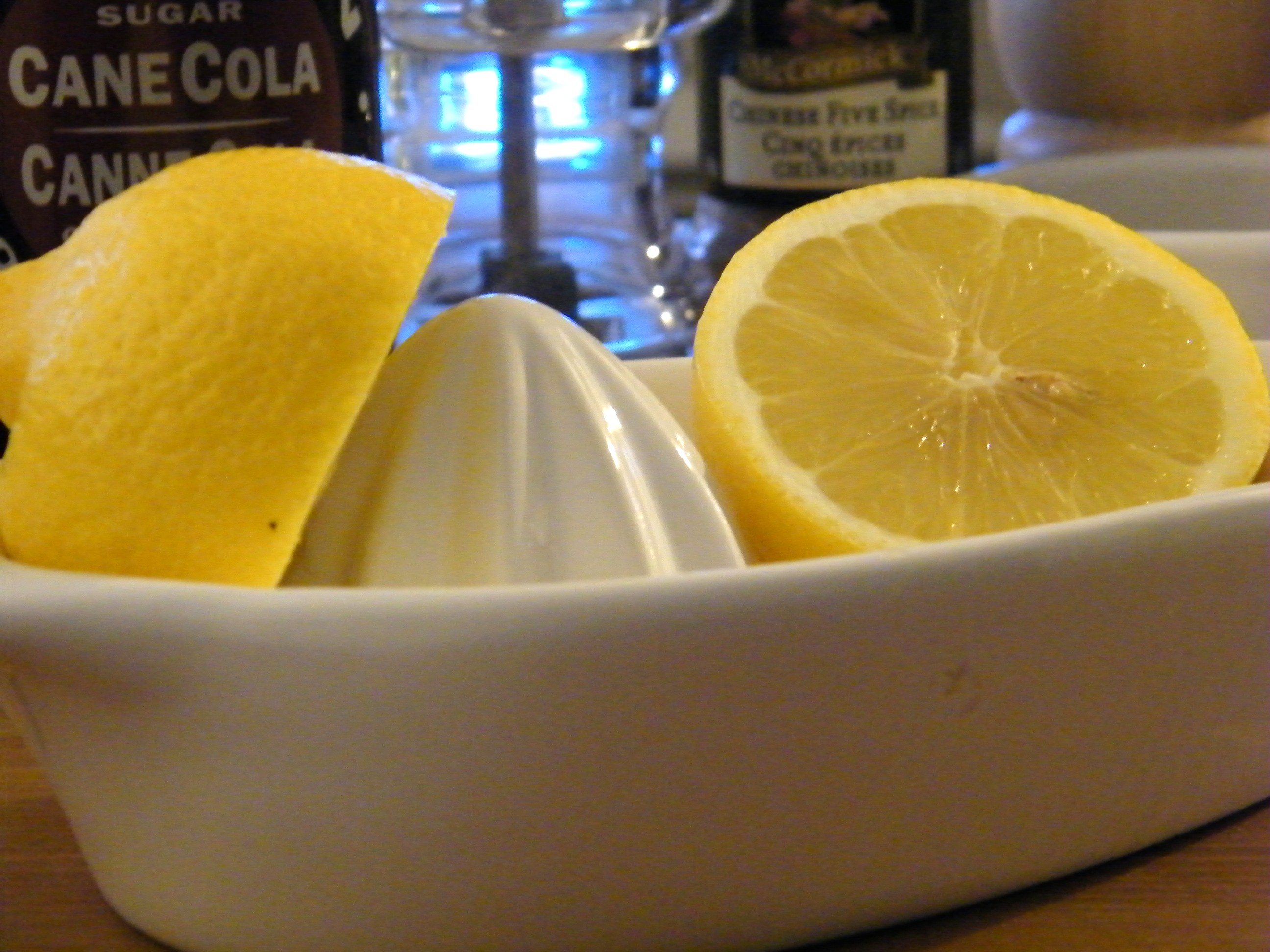
A split lemon resting in the juicer.

All of this is to say that I’m paying attention to hockey right now and this week’s French Fridays recipe is a perfect fit. Cola and Jam Spareribs, steamed bok choy, mashed potatoes and Gewürztraminer, plus a winning home team game. Not bad for a Friday night at home. At least that was the plan. As of this writing, the ribs have just come out of the oven and we’re planning to eat them tomorrow, though we may have a few as a late-night snack, just to make sure they’re acceptable.

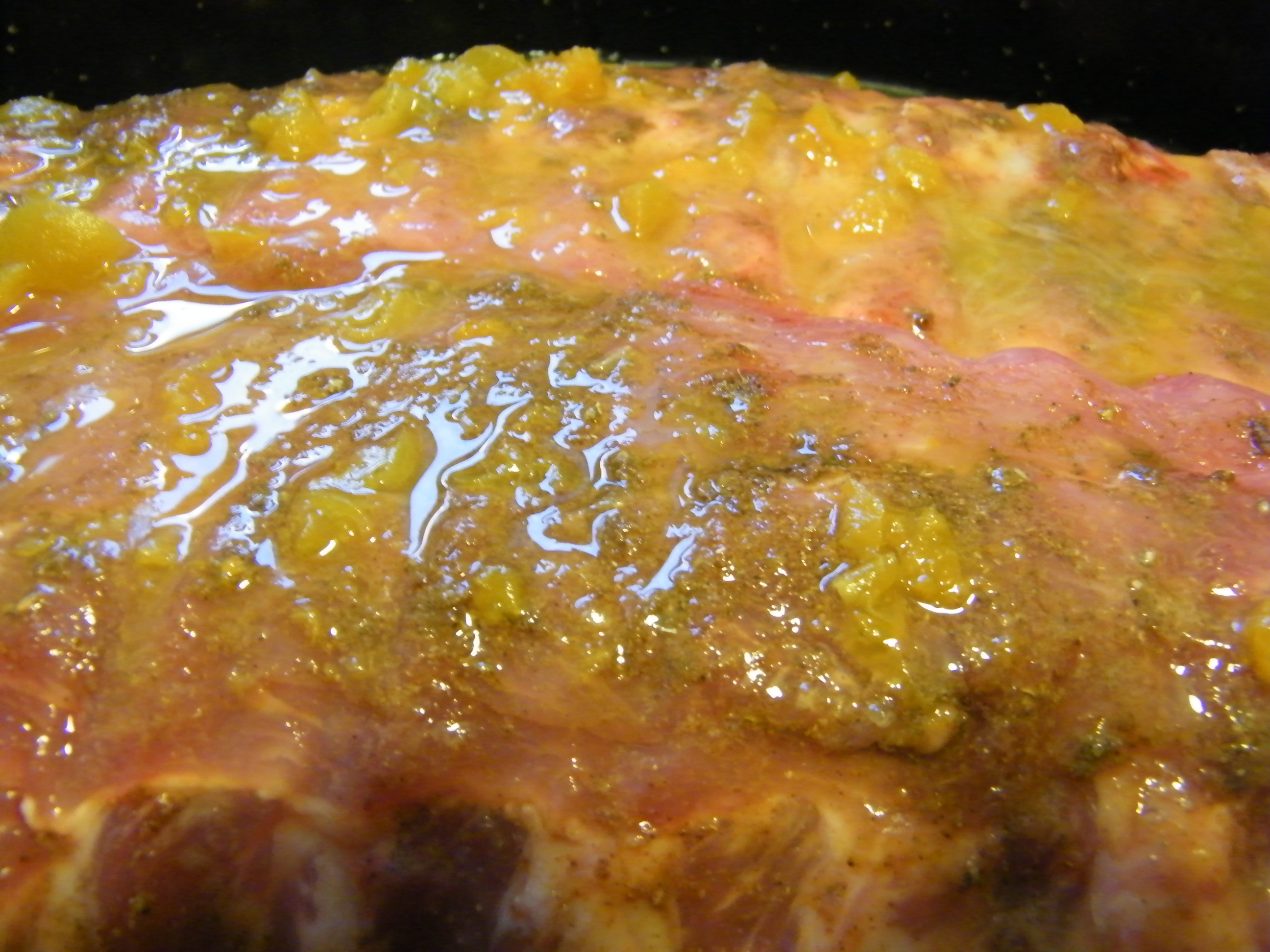
Ribs ready to go in the oven. You can see the jamminess of the marinade.

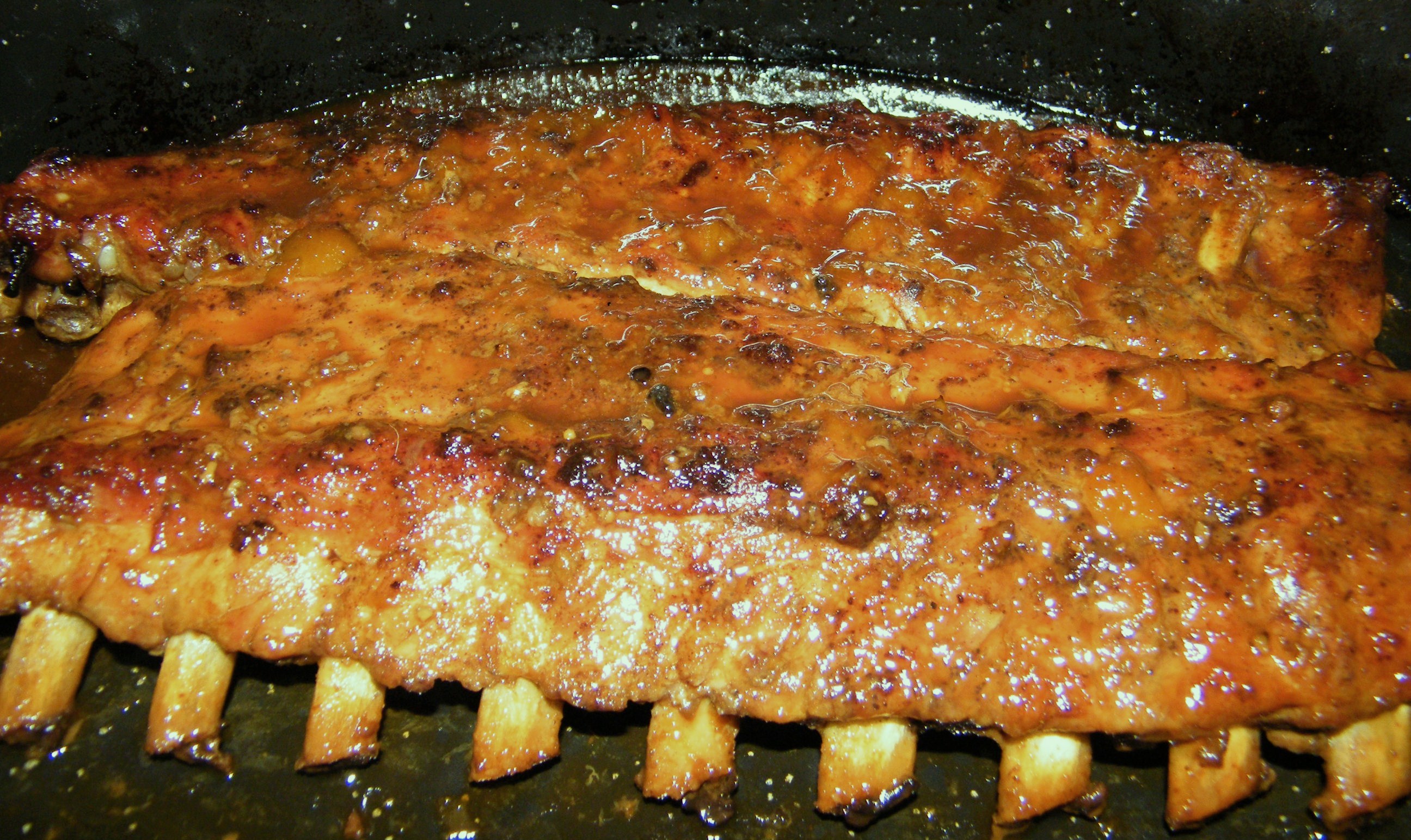
The aroma from the kitchen certainly promises that they’ll be more than acceptable. This isn’t a typically saucy rib recipe. The meat is rubbed with five spice powder, ground ginger, salt and pepper, then marinated in apricot jam, mixed with orange and lemon juices. Late in the roasting process, cola is added to the pan. It’s a long cooking time, with regular basting, but the meat is awfully tender looking. I’ll let you know in the comments how we liked it.

Nicely browned, just out of the oven.

You can find many other blogged descriptions of this week’s FFWD recipe here: Cola and Jam Spareribs