
Imperfection

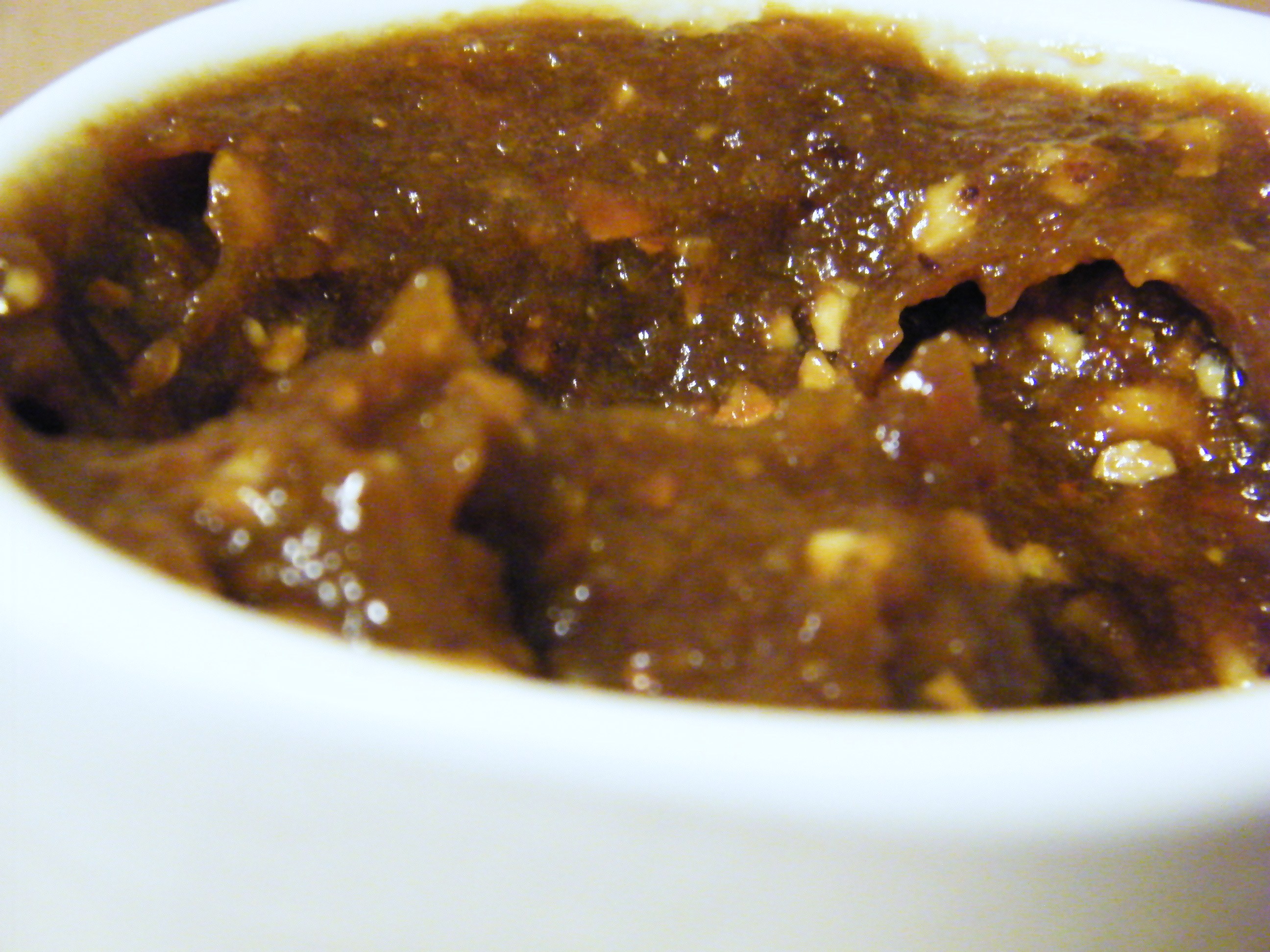
Apricot Lekvar

I made apricot lekvar last week, in preparation for Tuesdays with Dorie‘s latest assignment. My nieces were baking rugelach and I wanted to give them a head start.

I used organic, unsulphured, dried apricots to make the lekvar, which gave it a brownish cast rather than the jarred sunlight look described in the recipe. The apricots themselves look dubious, with dark spots that could be misread as the signs of spoilage. If you dare to try them, though, the taste of apricot is as present as in the most pristine looking, treated variety.

Scraping the lekvar out of the food processor.

The rugelach weren’t perfect, either. The girls rolled the rugelach up the length of the dough, rather than across, which gave them enormous rolls. When they sliced the cookies, what they ended up with could be described as rugelach pinwheels, the size of small cinnamon buns. Not exactly traditional. But, dredged in the nut-sugar-cinnamon topping, baked, and packed into a pretty tin, they were gorgeous. They were also a hit at the hockey game that night, when a big crowd of extended family, co-workers, and friends took over a couple of sections at the Giants game.

Perfection isn’t everything to me. Perhaps it should be, but I’m too often pleased with the serendipitous results my mistakes and experiments bring. I wouldn’t trade those rugelach pinwheels my nieces made for someone else’s correct version, though I’m certain they’ll roll them differently when they make them again. I’d also rather have my unprepossessing, organic version of lekvar than the most golden, conventional variety.

Rugelach, cooling on wire racks.

Perfection and imperfection can be a matter of perspective, after all. I also believe that it’s imperfection that leads us to new discoveries, spurs us to try harder, and keeps us from complacency. So here’s to experiments that don’t turn out as expected and mistakes with delicious results. We learn from them, stop to consider their implications, and continue.

Social Media from the Roots – Northern Voice 2011

I’m good at figuring things out and learning things on my own, but I like taking classes and learning in a group environment. It not only exposes you to the knowledge of instructors and other students, but I also find my own thoughts and ideas quickening when I’m sharing them with others. So, when I started this blog, I knew at some point I’d want to do some learning away from my computer screen.

This weekend, I did just that. Northern Voice is a social media conference based in Vancouver and is in its seventh year. The conference is organized by volunteers and has a grassroots ethos to it. You won’t find corporate swag bags, but you will find media professionals, artists, amateurs and enthusiasts gathering to learn from each other. The participants are drawn mostly from around BC, as well as the Pacific Northwest in the US.

I knew that I was going to like this conference as soon as Day One’s keynote speaker began her presentation. April Smith of AHA Media spoke about using social media to democratize media and to provide coverage of Vancouver’s Downtown Eastside as a member of the community. Beginning a conference with such a dynamic, grassroots perspective is so different from what professional/corporate events provide. It’s a much needed perspective.

Day Two’s keynote speaker was Chris Wilson of Google. His presentation was well-tailored to the audience, too, bringing a technological perspective to the idea that the social media and blogging worlds cater to the long tail of interests – there’s room for a lot of diversity in these spheres.

Highlights from Day One:

The Courting Controversy session:
Don’t be controversial for its own sake, because you’ll be called on to back up your claims.

Photocamp:
Leah Gregg’s photos
Roland Tanglao’s exhortation to shoot daily
Jeremy Lim’s advice to shoot less so you can notice more

Communities that Rock:
There was more information in this session than a newish blogger like me could even get down on paper, but what stuck with me most was that you need to work at making your blog visually appealing, giving your readers opportunities to interact beyond comments and keeping your blog posts fresh by varying form and content.

Highlights from Day Two:

Grassroots Campaigns
It was fascinating to hear the evolution of the presenters’ various social media and offline campaigns.
– Keeping your message simple, then translating the interest and support into offline actions is key
– Complexity can come later
– Simplicity doesn’t have to cancel out diversity

Looking Through the Lens
Alan Levine led us through a presentation of gorgeous photos and discussed the impact of aperture, shutter speed and ISO on photo quality. He also encouraged us to shoot daily, through communities like The Daily Shoot, which provide feedback as well as incentive.

DS106
The DS106 Radio crew took a university course and turned it into a Wild West of internet radio experimentation. Great storytelling.

Awesome-izing Your Podcast
v, an experienced broadcaster, gave us a wealth of information on best podcasting practices. What it boiled down to, though, was creating a sense of intimacy in your recordings.

I encourage you to click through to the Northern Voice conference schedule link at the top of the post – there were many more sessions and the schedule has lots of links to the fantastic presenters’ sites.

And lest you think it was all session and no play, I’ll leave you with a photo from the wine tasting room.

Why I’m here

I was one of those students who did well in high school writing assignments by writing to expectations. I’d been turned off by grammar and usage mechanics by an overly prescriptive teacher and came to prefer learning through sentence combining exercises and looking at the overall structure of good writing. I read widely and obsessively then and I think that I was unconsciously emulating the structure of the writers I admired.

When I went to University, I was shocked to find out that my writing wasn’t up to my instructors’ expectations. For the first time, my papers were covered in red ink and it scared the hell out of me. I responded by taking every writing course I could for the rest of my time there. The first writing book that really helped me to improve was Peter Elbow’s Writing With Power. His methods helped me to break myself of my habit of trying to write a paper from start to finish in one sitting. I was also able to write prose creatively for the first time.

By the end, I felt like a competent writer and sometimes even a good writer. I dabbled in writing, mostly for a (now defunct) feminist newspaper and brought my skills to the lousy administrative jobs I landed. My friends and I had moved on from academic writing and were looking to books like Natalie Goldberg’s Writing Down the Bones for guidance. We spent an embarrassingly large amount of our time doing writing exercises in cafés. Luckily, only my friend Julian was confident enough to read his work at open mike nights. I think he sticks to physics these days.

Over the years, I continued to take some writing courses, mostly technical writing, but with some creative non-fiction as well. Eventually, though, I stopped doing much personal writing. Instead, I got bogged down in the corporate miasma of business writing. I’m out of the corporate world now and I’m hoping it’s for good.

This blog is, in part, a way to reignite my writing process and to rebuild my skills. It’s also a way to engage with ideas and events that interest me, of course. And an opportunity to explore photography a little more.

I hope it becomes a way of engaging with you, too.

Stay tuned for a bonus post Friday evening. Gluten-Free Girl and the Chef are compiling a holiday meal recipe bank and have a great giveaway to go along with it. I’ll be posting my contribution and not just because I’m hoping to win the KitchenAid. I think having a gluten-free holiday recipe resource to share with family and friends will help a lot of people, including my partner. Be sure to check out their blog post for all the recipes.