
I received a review copy of The Complete Wild Game Cookbook from Robert Rose Inc. Nevertheless, all opinions in the following post are my own.
Now that butcher shops are back in vogue, people are becoming more familiar with meats that don’t find their way to the cold cases of the supermarkets. Venison, elk, and bison are regular offerings at the local butcher shops in my neighbourhood, along with duck, goose, and specialty sausages.
But my source for game meats has always been my family. My mother and I are the only ones who don’t hunt. Her asthma is too severe and I…well, let’s just say the poor eyesight and hearing that have dogged me since childhood aren’t advantages when you’re stalking prey.
I’ve always appreciated the game they’ve sent my way, though. It’s healthier than much of the meat that’s been available until recently and it’s a more ethical choice than factory-farmed meat, as well.
My daily diet is largely plant-based, but when I do eat meat, wild game is up at the top of my list. It’s delicious, with a wide range of flavour affinities that can differ from those of chicken, pork, and beef.
All of which is to say that it’s not surprising that I leapt at the opportunity to review The Complete Wild Game Cookbook by Jean-Paul Grappe.
It’s been a recurring theme in this round of cookbook reviews – books that include recipes but are much more than recipe books. This cookbook is no exception. It includes 165 chef-authored recipes, but it’s also a history of the way people in Quebec have approached their edible landscape. It’s a handbook of the game animals, seasonings, and edible plants that populate the region. It’s a guide to best practices when obtaining and using game meats. It’s also a manual for gaining the foundational skills that can help you become a more sophisticated and accomplished cook.
What it’s not is a book for absolute beginners in the kitchen. There are photo guides to some of the techniques used in the book, along with a compendium of useful stock and sauce recipes, and a glossary of cooking terminology. But, you’ll still need enough experience to know when a piece of meat is seared enough to go into the oven, or what constitutes “doneness” in a piece of meat, or how to balance seasonings in a sauce.
The good news is that you don’t have to be a deeply experienced cook to be able to use this book. If you’ve been successful with a basic cookery book like The Joy of Cooking, you’re ready for this one. The instructions are clear and complete, there are meat thermometer temperature guides throughout, and plenty of serving tips and suggestions for variations.
I couldn’t wait to dig into the recipes when I got my hands on the book, but ended up spending time reading about Grappe’s philosophy toward game, instead. He advocates respect for the animal, from ethical stalking practices to ensuring that if you take an animal, you must use all of it. This respect for the animal that feeds you is repeated throughout the book and is paired with a respect for the provenance of recipes. Recipes from other chefs are clearly credited and many of Grappe’s recipes are listed as being in honour or memory of other chefs, as well. The recipes in this book exist within the physical ecosystem of a region and the relational ecosystem of a cooking tradition.
I did, of course, turn to the recipes quite quickly. My first impulse was to concentrate on venison and elk, with recipes like Licorice-Scented Short Ribs Cooked with Baby Yellow Beets or Osso Bucco-Style Venison Shank catching my attention. And the Venison Chops with Asian Spices has already become a favourite.
But, my father came home with some beautiful grouse just when I was deciding upon a recipe to share on the blog. So, I settled on Asian-Flavored Guinea Fowl Suprêmes and my parents sent me some grouse breasts to use in place of the guinea fowl.
Asian-Flavored Guinea Fowl Suprêmes
Serves 4
• Preheat oven to 400°F (200°C)
• Ovenproof skillet
• Meat thermometer
- 1 tbsp (15 mL) butter
- 1 shallot, minced
- 2 tbsp (30 mL) granulated sugar
- 2 tbsp (30 mL) white wine vinegar
- 2 cups (500 mL) unthickened brown poultry stock or store-bought equivalent
- 2 tbsp (30 mL) hoisin sauce
- 1⁄2 tsp (2 mL) hot sauce
- 2 tbsp (30 mL) peanut butter
- Salt and freshly ground black pepper
- 4 guinea fowl breasts, deboned, skin removed
- Heat butter in a skillet over medium heat. Add shallots and sweat. Add sugar and caramelize, stirring often, until golden brown, 3 to 4 minutes.
- Deglaze skillet with wine vinegar. Add poultry stock, hoisin sauce, hot sauce and peanut butter and reduce by half. Season with salt and black pepper. Pour sauce through a fine-mesh strainer. Set aside in a warm place.
- In an ovenproof skillet, sear guinea fowl breasts over medium heat. Cook in preheated oven until a thermometer inserted in center of breast registers 175°F (80°C), 10 to 12 minutes.
- To Serve: Pour sauce onto individual serving plates and lay breasts on top.
Recipe by Chef Danielle Neault
Serving Tip: Accompany with small sautéed mushrooms or extra-fine green beans.
Courtesy of The Complete Wild Game Cookbook by Jean-Paul Grappe © 2015 http://www.robertrose.ca Reprinted with publisher permission. Available where books are sold.
Recipe photo credit: Mitch Mandel/Rodale Images

This is the kind of recipe that will convince your guests that you’ve taken cooking classes, though really, it’s not difficult at all.
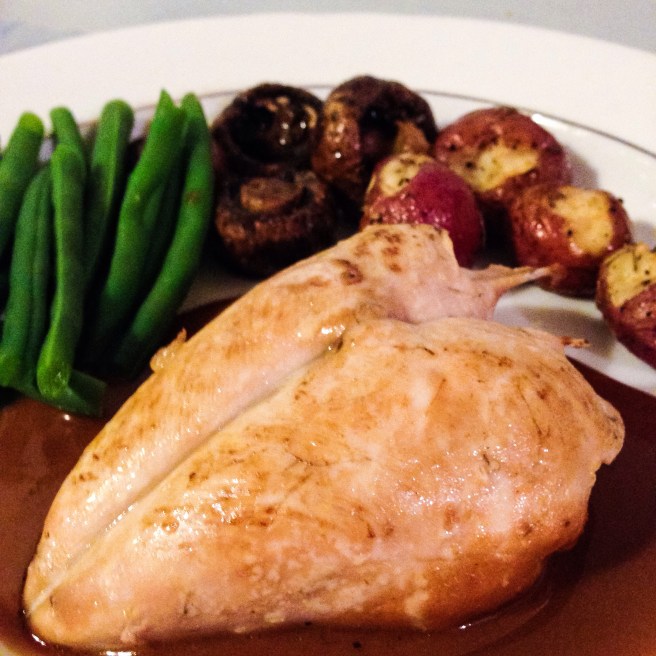
Like many of his recipes, there are suggestions for several substitutions. In this case, Grappe suggests you use duck, grouse, or chicken in place of the guinea fowl. I used grouse and chose to leave the meat on the breast bone, as grouse are quite small and I wanted to preserve as much meat as possible.
I also used some homemade chicken stock in place of brown poultry stock, adding a touch of tomato paste to make up for the lack in the stock. The sauce itself is interesting, as you make a sort of shallot caramel at the start, then add the rest of the elements after deglazing the pan with white wine vinegar. (This is another instance where a little experience in the kitchen helps with this book. If I wasn’t familiar with seized caramel and didn’t know that it melts right back into the mixture as it cooks, I might have been discouraged early on.)
The finished sauce is thick and velvety, with an emphasis on peanut and hoisin and an undercurrent of heat from the hot sauce. I want to make big batches and keep it in the fridge for use with almost anything I eat. If I can come up with a vegan and gluten-free version, it could easily become our house sauce.
The grouse is quite simply prepared, seared and then roasted for a short time at high heat. Grappe provides the internal temperature the meat needs to achieve, so as long as you’ve got a meat thermometer, it’s difficult to go wrong. I tented the breasts with foil when they came out of the oven, so they could rest while I plated the sauce and sides. The grouse was perfectly done, juicy and tender. The sauce complemented it well, especially since the preparation of the grouse was so plain and the sauce is full of flavour.
I served it with mushrooms I roasted at the same time as the grouse (in a separate pan), roasted potatoes I’d prepared earlier, and some blanched green beans. It was a satisfying meal.

This is a book that I’ll consult whenever I get hold of some game, but I’ll use it for inspiration with other meats, too. A number of the recipes are suitable for chicken, pork, or beef and there are so many flavours to explore in the book. The recipes have a range of culinary influences, from classic French flavours to Asian seasonings, all of which sound delicious and often elegant.
I do have one caveat – you might not be able to find all the ingredients, like cloudberries or cattail hearts, where you live. It’s not an onerous problem, though, as a little internet investigation will yield plenty of local substitution possibilities.
There are also a number of recipes for meats that I won’t be using, whether they’re recipes for songbirds that are no longer legal to hunt, or for animals like beaver, seal, or squirrel which just aren’t coming to table. Those recipes are still worth exploring and experimenting with substitutions. It’s also part of the book’s encyclopedic aspect – this is in part a documentation of the foods that have influenced Quebecois regional cooking.
Overall, this is a book that is perfect for omnivores who want to refine their cooking, would like to expand the range of foods they include on their tables, and care about where their food comes from. In the short time I’ve had the book, I’ve already learned quite a bit. I encourage you, even if you’re not familiar with game, to explore these foods, too.

Gift Giver’s Guide: For the hunter, the gastronome, the autodidact, and the adventurer.
Come back December 31th for a review of a book that will have you sharpening your knives.


 One Wet Foot