The Spring Hermit’s Bookshelf

IMG_3483

So many of my friends across the continent are dealing with a harsh winter, while I’m contemplating planting the first seeds in the garden. I almost wouldn’t mind being snowed in, though – it’s been a long time since I’ve had a snow day and there’s nothing like cooking, baking, reading, and dreaming from a cozy vantage point on an icy world.

Except for doing all that, while also being able to go on long, sunny walks in the fresh spring air. I should just enjoy it before the rains start again, shouldn’t I?

And really, who needs an excuse to hunker down with a good book?

I just finished Vikram Chandra’s Geek Sublime and it was every bit as good as I expected it to be. I love writers who can take seemingly disconnected subject matter and weave the threads together into a greater whole. Chandra’s book explores code, but also colonialism, Indian and Western literatures, writing, and more.

I also have a bookshelf standoff happening between Alice Medrich’s Flavor Flours and Rose Levy Beranbaum’s Baking Bible. Actually, the only conflict they’re creating is whether or not I can justify adding two more beautiful books to the groaning shelves of our cookbook bookcase.

Here are some other excellent recent reads:

Once Upon a Time: A Short History of Fairy Tale by Marina Warner – deceptively small, for such a rich and comprehensive survey of a subject, rather like a magical object in a fairy tale.

How Paris Became Paris: The Invention of the Modern City by Joan DeJean – for those who dream of architecture and cultural formation, along with the romance of Paris.

Station Eleven by Emily St. John Mandel – a post-apocalyptic vision that sees more than just dissolution.

The Unspeakable: And Other Subjects of Discussion by Meghan Daum – a bracing book of essays.

Information Doesn’t Want to Be Free: Laws for the Internet Age by Cory Doctorow – copyright from a socially just perspective.

And coming up:

Vivid Faces: The Revolutionary Generation in Ireland, 1890-1923 by RF Foster

Moving Targets: Writing With Intent, 1982-2004 by Margaret Atwood

Bad Feminist by Roxane Gay

After that, I think I should get back outside. So, tell me, what are you reading?

Holiday Book Reviews – 300 Best Homemade Candy Recipes

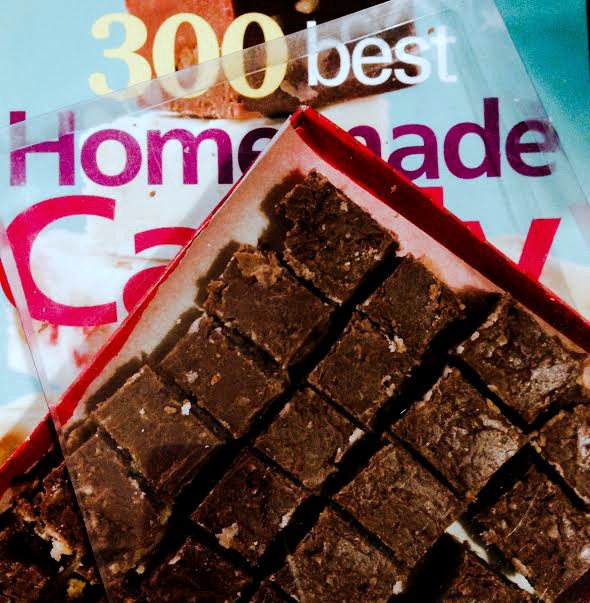
Fudge

I don’t know about you, but this is the week when my Christmas shopping always begins in earnest. So, for the second year in a row, I’m bringing you three book reviews to help you cross a few names off your list.

I received a review copy of 300 Best Homemade Candy Recipes from Robert Rose Inc. Nevertheless, all opinions in the following post are my own.

My mother’s aunts were tiny women with very strong arms. That’s because they were raised in an era without stand mixers or food processors to help them in the kitchen. One of the things they used their strength to make, in quantities great enough for the whole extended family, was the French Canadian specialty sucre à la crème. This simple fudge was something we looked forward to at Christmastime and my great-aunt Leona taught me how to make it when I was a teenager. Until very recently, sucre à la crème and truffles were the only candy recipes in my repertoire.

Enter Jane Sharrock’s 300 Best Homemade Candy Recipes. I’ve been curious about candy making for some time now, so when I got the opportunity to review this book, I jumped at it. Sharrock’s cookbook covers most of the categories of candy you can find in a kitchen and some, like lollipops, that I never dreamed you could make at home.

Sharrock began collecting candy recipes when her mother gave her a treasured pressure cooker that was perfect for making candy, along with a small booklet of candy recipes. Sharrock went on to try to preserve the candy recipes from earlier generations, which lends her cookbook an air of nostalgia. Reading through the recipes, I get the sense that these candies populated the tables at church bazaars and community potlucks, in the days before mass-produced sweets took their place.

This means that for the most part, the recipes use ingredients that you’d easily find at the supermarket. The few specialty items, like candy coating, can be found at baking supply stores. But, just because these recipes are old fashioned, doesn’t mean that they’re all unsophisticated. The pralines, divinity, and nougats would make a sweets table shine and even recipes that were thought of as homey, like taffy, seem very impressive these days. You won’t learn skills like tempering chocolate or making marshmallows from scratch, but once you’ve mastered this book, taking your candy making to the next level will be a breeze.

What I like best about this book is that it teaches you a wide range of candy making skills, includes troubleshooting advice and photo demonstrations, and even guides you through the steps you’d need to take if you were trying to recreate a favourite candy without the recipe.

I think after working through some of Sharrock’s categories of sweets, next year’s holiday treat boxes will be the best they’ve ever been. In the meantime, I’m going to give Sharrock’s tuxedo fudge another try. I forgot to put the coconut into the bottom layer and added it to the top, instead. As a result, the bottom is creamy, but the top is a bit dry. Following the instructions should make my next attempt perfect. Thanks to Robert Robert Rose, Inc., I’m sharing the recipe with you. If you’re still on holidays next week, it would be a great way to start filling your freezer with goodies before the New Year’s resolutions set in.

Boxed

Tuxedo Fudge

Makes about 3 1/2 lbs (1.75 kg)

8- or 9-inch (20 or 23 cm) square pan, lined with parchment or buttered
2-quart heavy saucepan
Candy thermometer

Coconut Layer
2 cups (500 mL) granulated sugar
Pinch salt
1/2 cup (125 mL) butter or margarine
1/4 cup (60 mL) light (white) corn syrup
1/2 cup (125 mL) milk
1 tsp (5 mL) vanilla extract
1/2 cup (125 mL) sweetened flaked coconut

Chocolate Layer
2 cups (500 mL) granulated sugar
2 tbsp (30 mL) unsweetened cocoa powder
Pinch salt
1/2 cup (125 mL) butter or margarine
1/4 cup (60 mL) light (white) corn syrup
1/2 cup (125 mL) milk
1 tsp (5 mL) vanilla extract
1/2 cup (125 mL) pecans, in large pieces (optional)

1. To make the coconut layer: In heavy saucepan over low to medium-low heat, bring the sugar, salt, butter, corn syrup and milk to a boil, stirring until the sugar dissolves and the mixture begins to boil. Cover and cook 2 to 3 minutes to dissolve the sugar crystals on the sides of the pan. Remove the lid. Cook, stirring only as needed to prevent scorching, to the soft ball stage (234°F to 240°F/112°C to 116°C, with 236°F/113°C recommended).
2. Remove from the heat. Cool slightly, about 10 minutes. Add the vanilla. Beat by hand until the candy begins to thicken and lose its gloss. Stir in the coconut. Spread the candy into the prepared pan. Cool at room temperature while making the chocolate layer.
3. To make the chocolate layer: In a clean saucepan, combine the sugar and cocoa until well blended. Add the salt, butter, corn syrup and milk. Bring to a boil over low to medium-low heat, stirring until the sugar dissolves and the mixture begins to boil. Cover and cook 2 to 3 minutes to dissolve the sugar crystals on the side of the pan. Remove the lid. Cook, stirring only as needed to prevent scorching, to the soft ball stage (234°F to 240°F/112°C to 116°C, with 236°F/113°C recommended).
4. Remove from the heat. Cool slightly, about 10 minutes. Add the vanilla. Beat by hand until the candy begins to thicken and lose its gloss. Stir in the pecans, if desired. Spread the chocolate layer over the coconut layer in the pan. Cool and cut into squares. Store in an airtight container.

Gift Giver’s Guide: For the sweet tooth, the nostalgic, and the cook who wants to extend their gifts from the kitchen beyond cookies and squares.

You can find the rest of this year’s reviews here and here..

Holiday Book Reviews – Plenty More

/home/wpcom/public_html/wp-content/blogs.dir/ba0/6971813/files/2014/12/img_3269.jpg

I don’t know about you, but this is the week when my Christmas shopping always begins in earnest. So, for the second year in a row, I’m bringing you three book reviews to help you cross a few names off your list.

I received a review copy of Plenty More from Appetite by Random House Canada. Nevertheless, all opinions in the following post are my own.

It’s only been in the last couple of decades that North Americans have rescued vegetables from their role as either abstemious “rabbit food” or underloved sidekick. Even today, many restaurants use vegetables more as a garnish than a true part of the meal on the plate. As much as I love a good steak, I’ve always craved more than a tiny pile of over-steamed carrots to accompany them. I want vegetables to receive the same care and attention, and creativity, that is brought to the proteins and starches in my meal.

At home, there are plenty of great cookbooks that celebrate proteins, side dishes, and desserts, but until recently, scant attention has been paid to vegetables. Yotam Ottolenghi, along with writers like Deborah Madison and Barbara Kafka, has changed all that.

I’ve been a fan of Ottolenghi since I discovered his Guardian column on vegetarian cooking a number of years ago. Not only did he make vegetables the centre of attention in his dishes, but he used them as a canvas for many of the herbs and spices that were just coming to the attention of British, Australasian, and North American eaters. Middle Eastern flavours like za’atar and harissa were showing up with the proteins on restaurant menus. Ottolenghi’s column, then his cookbook Plenty, sent vegetarians and vegetable-lovers to the spice rack, too.

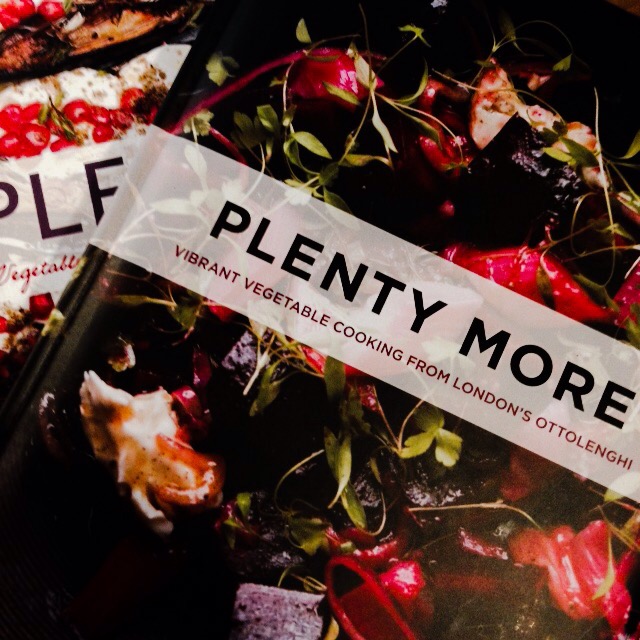
When I found out he was coming out with a sequel to Plenty, I was excited. My copy has seen a lot of use and I was ready for more recipes. Unlike Plenty, which is organized by vegetable type, Plenty More‘s chapters cover techniques, from tossing to roasting to baking. It’s an evolution from exploring vegetables to becoming so comfortable with them that experimentation begins.

When I got my copy of Plenty More, I took the Roasting chapter for a spin, first thing. In the cold damp of a Vancouver winter, roasted meals warm the kitchen and the belly. I started with Squash with Cardamom and Nigella Seeds, which I served with a Moroccan tagine. Then, I tried the recipe I’m sharing with you today.

One of the reasons I think people believe vegetables are boring is because we’re afraid to work with them as vigourously as we do a piece of meat. Even roasted vegetables can be a bit wan if you don’t allow them to brown and caramelize. That’s one lesson Plenty More brings home. Both the recipes I tried allow the dish to develop the smoky, jammy flavours that come only when you roast something fearlessly.

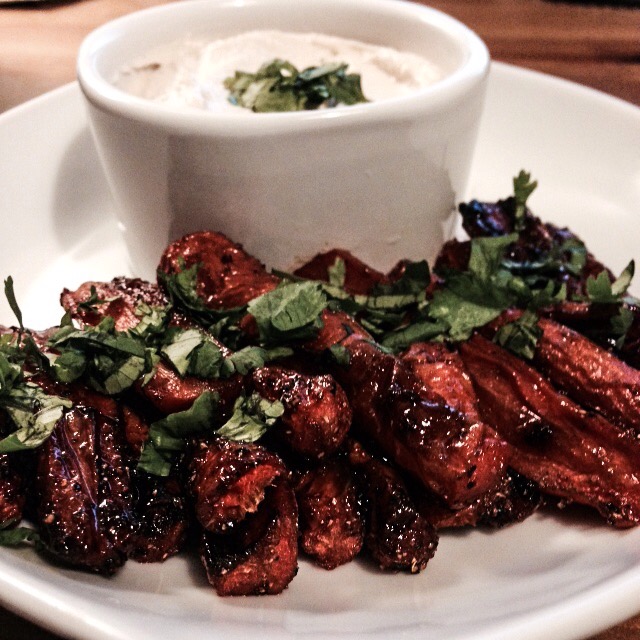
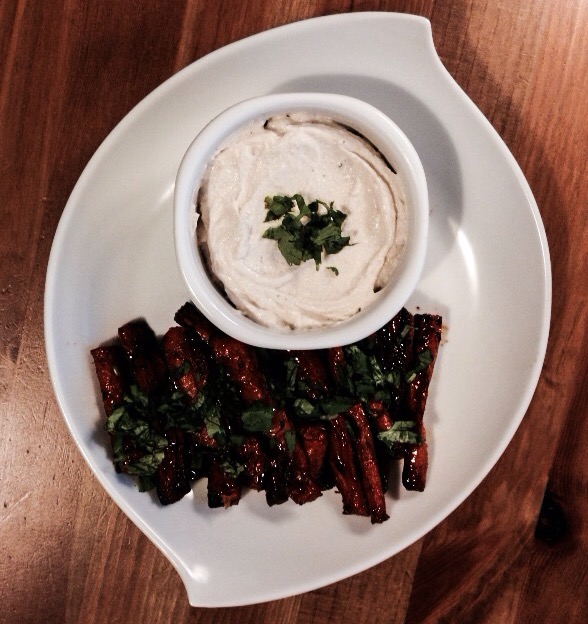
This recipe gives you perfectly tender carrots with a crust of caramelized honey and accompanies it with a fresh yogurt and tahini sauce that provides a wonderful counterpoint to the dish.

/home/wpcom/public_html/wp-content/blogs.dir/ba0/6971813/files/2014/12/img_3270.jpg

Honey-Roasted Carrots with Tahini Yogurt

Serves Four

scant 3 tbsp/60 g honey
2 tbsp olive oil
1 tbsp coriander seeds, toasted and lightly crushed
1 1/2 tsp cumin seeds, toasted and lightly crushed
3 thyme sprigs
12 large carrots, peeled and cut into 3/4 by 2 1/2-inch/2 by 6-cm batons (3 lb/1.3 kg)
1 1/2 tbsp cilantro leaves, coarsely chopped
salt and black pepper

Tahini yogurt sauce
scant 3 tbsp/40 g tahini paste
2/3 cup/130 g Greek yogurt
2 tbsp lemon juice
1 clove garlic, crushed
salt

Preheat the oven to 425°F/220°C.

Place all the ingredients for the tahini sauce in a bowl with a pinch of salt. Whisk together and set aside.

Place the honey, oil, coriander and cumin seeds, and thyme in a large bowl with 1 teaspoon salt and a good grind of black pepper. Add the carrots and mix well until coated, then spread them out on a large baking sheet and roast in the oven for 40 minutes, stirring gently once or twice, until cooked through and glazed.

Transfer the carrots to a large serving platter or individual plates. Serve warm or at room temperature, with a spoonful of sauce on top, scattered with the cilantro.

/home/wpcom/public_html/wp-content/blogs.dir/ba0/6971813/files/2014/12/img_3271.jpg

Once you’ve tried this dish, I suspect that you’ll be buying a copy for yourself as well as the person you were shopping for. I love that I can adapt most of these recipes easily for my vegan partner, while making the meat-eaters at my table forget that they’re being served a vegetarian meal.

Gift Giver’s Guide: For the vegetable lover, the curious cook, the flavour-seeker, and anyone who needs convincing that vegetables can be the star of the show.

Come back Tuesday for a review of a book that will fill your holiday sweets table with goodness.

Holiday Book Reviews – The Healthy Slow Cooker

Closeup

I don’t know about you, but this is the week when my Christmas shopping always begins in earnest. So, for the second year in a row, I’m bringing you three book reviews to help you cross a few names off your list.

I received a review copy of The Healthy Slow Cooker, Second Edition from Robert Rose Inc. Nevertheless, all opinions in the following post are my own.

I know that I post a lot about French food and desserts around here, but most of the time I try to cook healthy meals. It might seem challenging to do so when trying to balance the needs of an omnivore with a vegan-ish, gluten-free eater, but it isn’t really. We never ate very much bread with our meals and there are plenty of great grains that can satisfy our carbohydrate requirements. As for protein, I’ve always been of the mind that meat and dairy shouldn’t be the primary focus of weekly meals, so we were already eating a largely plant-based diet before my partner started his move toward veganism.

What can be challenging is making sure we have enough variety in our diet, so that we’re covering all the nutrient groups as we eat across the week. It’s easy to get into a routine, making the same few dishes over and over, with a little experimentation on the weekends. Much better to find ways to change things up more frequently.

One of my favourite ways to do that is to make use of my slow cooker. Not only can I fill it and forget it for the workday or overnight, having a large slow cooker means that I can make recipes in quantities that allow me to package and freeze several meals’ worth.

Unfortunately, a lot of slow cooker cookbooks focus on heavy meals that cycle through a limited roster of protein-starch-vegetable combinations. So, I was happy to find The Healthy Slow Cooker has a variety of recipes, both meat and plant-based, with a focus on using nutrient-dense ingredients. The best part is that all the recipes are gluten-free.

Judith Finlayson is well-known to Canadians as a writer and editor, but has become especially famous for her prolific publication of useful cookbooks. Many of them are slow cooker cookbooks, focusing on different health needs or dietary practices. The Healthy Slow Cooker is in its second edition, which came out earlier this year. This means that the recipes are updated, but more importantly, the nutrition tips and health information are more current now, too.

Those tips and information boxes, called “Mindful Morsels” and “Natural Wonders” are a welcome feature of Finlayson’s book. There are the kinds of information you might expect, like the sections breaking down the nutritional benefits of mushrooms or bell peppers, which help bring home the reasons for eating a wide variety of foods. But there are also sections that go into more depth, explaining the role of elements like fatty acids and micronutrients in our diets, why some foods which should always be bought from organic sources, or shopping with environmental concerns and sustainability in mind.

The recipes come from a number of culinary traditions, including Caribbean, Indian, Middle Eastern, and Asian flavours. They also make use of common ingredients, without ignoring some of the ingredients (think edamame or sunchokes) that have been showing up more and more in markets. There are lots of vegan or vegetarian dishes, while many of the recipes that weren’t explicitly vegetarian or vegan could easily be converted, like her Sweet Potato Coconut Curry. And most of the truly meat-based meals are freezable, ready for those times when I’m eating solo.

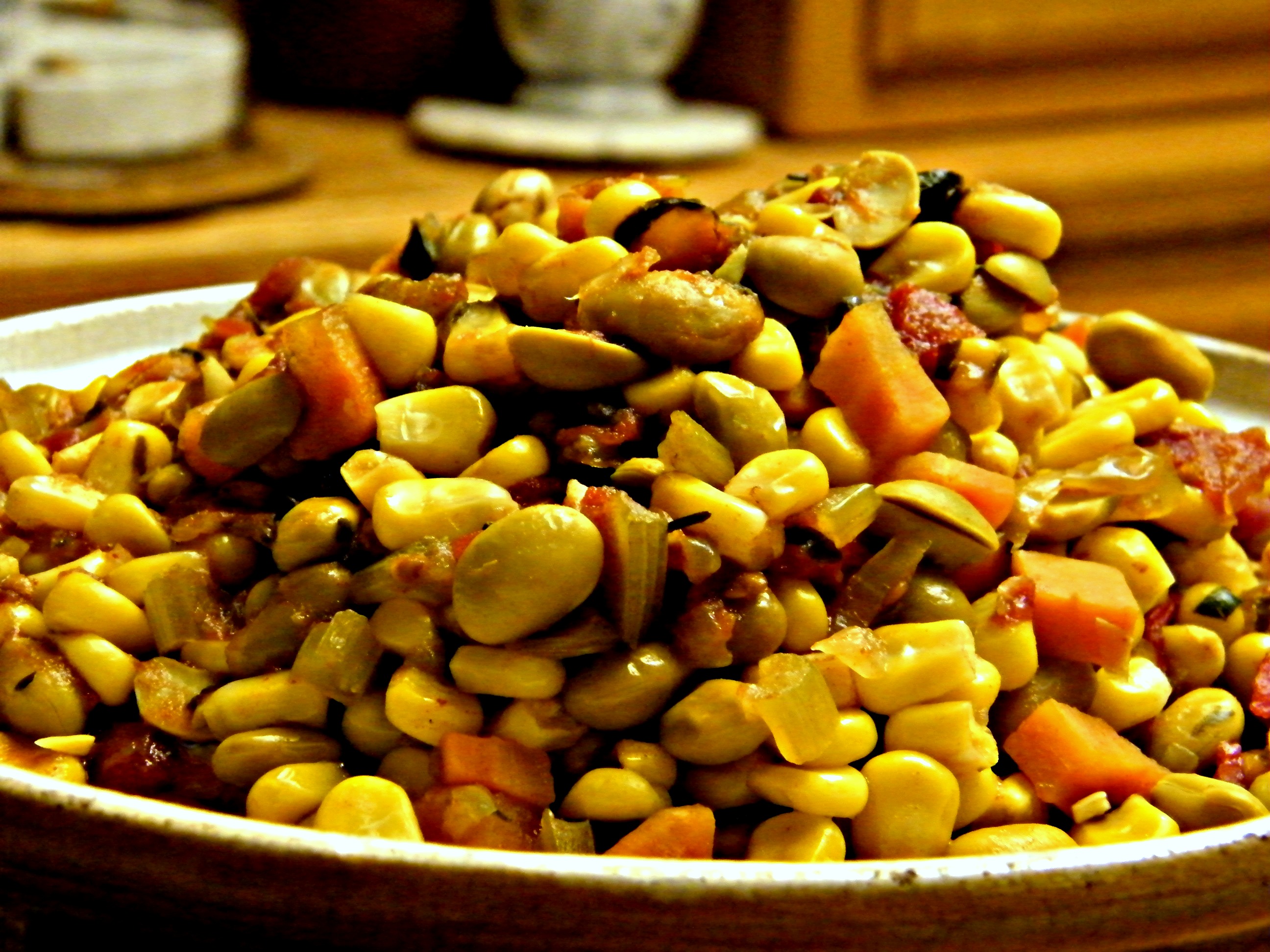
When I was deciding which recipe to share with you, I thought about how much of a boon fresh, vibrant food is on the winter table. Even though summer vegetables are long gone, many of them are available frozen, almost as nutrient-rich as when they were picked. Finlayson’s take on succotash was exactly what I was looking for, incorporating corn, roasted red peppers, tomatoes, and edamame with the warmth of paprika. It’s bright on the table, filling, and a good match for many different main courses. Best of all, it’s freezable, letting you enjoy it across the coldest months. (If you make it in summer, you can use garden-fresh ingredients and freeze some of it for winter.)

New Age Succotash

reprinted with permission from Judith Finlayson’s Healthy Slow Cooker

Serves 8

1 Medium to large (3 1/2 to 5 quart) slow cooker

1 tbsp (15 mL) olive oil
2 onions, finely chopped
4 stalks celery, diced
2 carrots, peeled and diced
4 cloves garlic, minced
1 sprig fresh rosemary or 2 tsp (10 mL) dried rosemary leaves, crumbled
1/2 tsp (2 mL) salt
1/2 tsp (2 mL) cracked black peppercorns
1 can (28 oz/796 mL) no-salt-added tomatoes, including juice, coarsely chopped
1 1/2 cups (375 mL) vegetable stock
4 cups (1 L) frozen shelled edamame
2 tsp (10 mL) paprika, dissolved in 2 tbsp (30 mL) water
4 cups (1 L) corn kernels, thawed if frozen
2 roasted red bell peppers, diced
1/2 cup (125 mL)finely chopped parsley leaves

In a skillet, heat oil over medium heat. Add onions, celery and carrots and cook, stirring, until softened, about 7 minutes. Add garlic, rosemary, salt and peppercorns and cook, stirring, for 1 minute. Stir in tomatoes with juice and vegetable stock and bring to a boil. Transfer to slow cooker stoneware.

Add edamame and stir well. Cover and cook on Low for 8 hours or on High for 4 hours, until mixture is hot and bubbly. Stir in paprika solution. Add corn, roasted red peppers and parsley and stir well. Cover and cook on High for 15 minutes, until corn is tender and mixture is heated through.

Variation
Spicy Succotash: For a livelier dish, stir in 1 can (4.5 oz./127 mL) mild green chiles along with the red peppers.

This is a terrific side for a braised tofu dish, or more traditionally, for a big platter of ribs. Finlayson includes a recipe for a corn and chile polenta in the cookbook, which would be a nice addition to either of these meals. Really, though, this dish would fit whenever you’d otherwise consider serving the usual boiled, steamed (or canned) vegetables.

I’ll be coming back to this cookbook often, both for the recipes and the information.

Gift Giver’s Guide: For the busy, the gluten-free, and those who want variety and flavour in their healthy menus.

Come back tomorrow for a review of a book that brings vegetarian eating to a new level.

A List of Lists for the Booklover

Old family photo

I’m not much for gift guides. I’d rather visit the multitude of craft fairs and art sales that happen this month. Keeping it local, supporting crafters and artisans, finding unique and special gifts – all those good things.

What I do fall for, every time, are book lists. And the end of the year is full of them.

The Big Picture

The New York Times has released their list of 100 Notable Books of 2014. Not to be left out, the Globe & Mail released their own list of 100. NPR and the CBC put out shorter lists, while the Guardian asked notable writers for their picks instead.

Publisher’s Weekly breaks their list down into categories. I’ve linked to their non-fiction list, because it starts with one of the best books I read this year, but you can click through to their other lists at the top.

Around the World

The Telegraph’s picks for the best travel books of 2014. And the Detroit Free Press’ picks. Shutterstock has a list of their favourite travel photography books and Longitude Books promises titles that will entice you to explore regions around the world.

In the Kitchen

If you’re a little obsessed with cookbooks, like me, there’ are a number of “best cookbooks of all time” lists. Here are a few, from:

Out in the Garden

A British list from Gardens Illustrated. An American one from the American Horticultural Society. One for Canadians from The Star. And finally, another British one that asks whether the subject of gardening has anything more left to be said.

Those should keep you busy, if you weren’t busy enough at this time of year. No shame if you use these lists only when shopping for yourself. Well, not much shame.

FFWD – Savoury Cheese and Chive Bread

The first cookbook I cooked from when I was a child was Betty Crocker’s New Good and Easy Cook Book. That’s not entirely true, of course, because I used to help my mother with recipes before I started to cook on my own. She had (and still has) a black-bound spiral notebook of her mother’s recipes, a number of different cookbooks on the shelf and a head full of recipes that she never wrote down. When I was ready to start making things on my own, though, I chose the Betty Crocker. I was mostly interested in baking and there were plenty of simple recipes to work my way through. My first brownies (regular and golden), snickerdoodles, Nanaimo bars and chocolate crinkles were made with recipes from this book. I delved into cakes and quick breads, too, eschewing the recipes that used boxed mixes, but embracing the Bisquick ones.

This week’s French Fridays recipe reminds me of the simplicity of the recipes I made when I was a kid, but with a sophisticated twist. The Gruyère alone makes this bread stand head and shoulders above the cheese bread I made with generic cheddar back then. Still, it’s a recipe that a child could make, once they’re ready to start baking on their own. That’s what I love about quick breads; they’re simple to make, with lovely results. When I made one loaf gluten-free, I didn’t even have to worry about over-mixing the dry ingredients, as it’s gluten that can make quick breads tough.

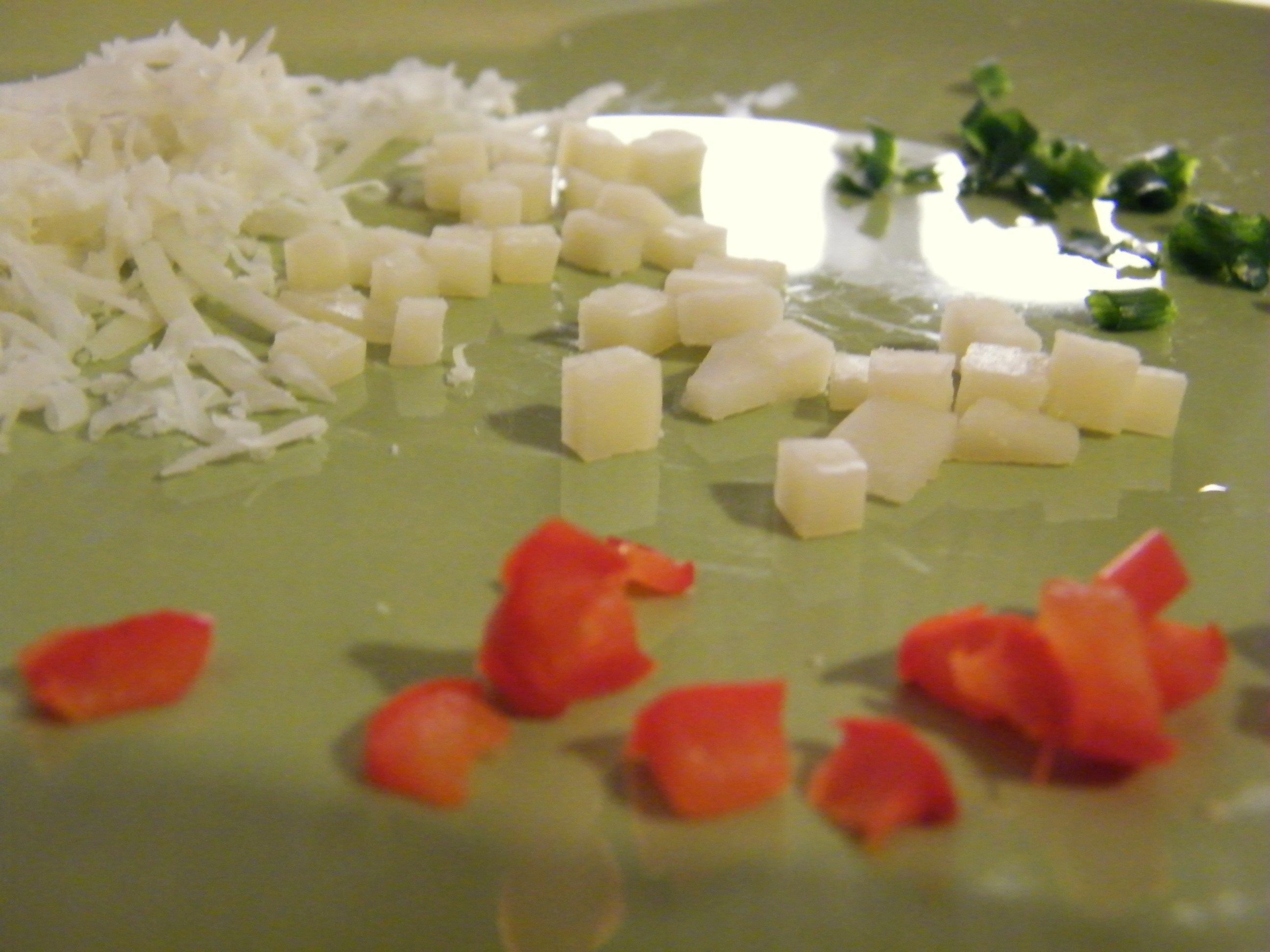
I’ve actually made this recipe twice. The first time, back in October when I first got Around My French Table, I made it with standard flour and a sharp, good cheddar cheese. I was at my parents’ house and baked it for them to use for lunches. I didn’t have the opportunity to taste it, but I heard that everyone enjoyed it. This week, I made it with a gluten-free all purpose flour and used Gruyère. I also added some tiny cubes of red pepper along with the chives. (Before I added the peppers to the mixture, I dried them out a little in a skillet over low heat on the stovetop.) Gluten-free breads can often have a very dry and crumbly texture, but not so for this bread. Though it was a little denser than the standard flour version, it was very moist and not at all gritty. I think this would be a good recipe to use a g-f flour mix that has teff in it, which might make the texture a little closer to the standard flour version. I’m also looking forward to trying some of Dorie’s bonnes idées for this recipe – it lends itself to a lot of variation.


Since there’s only two of us and because gluten-free bread doesn’t have a very long shelf life, I think I’m going to use the rest of the loaf to make a savoury bread pudding. There are some great ideas here.

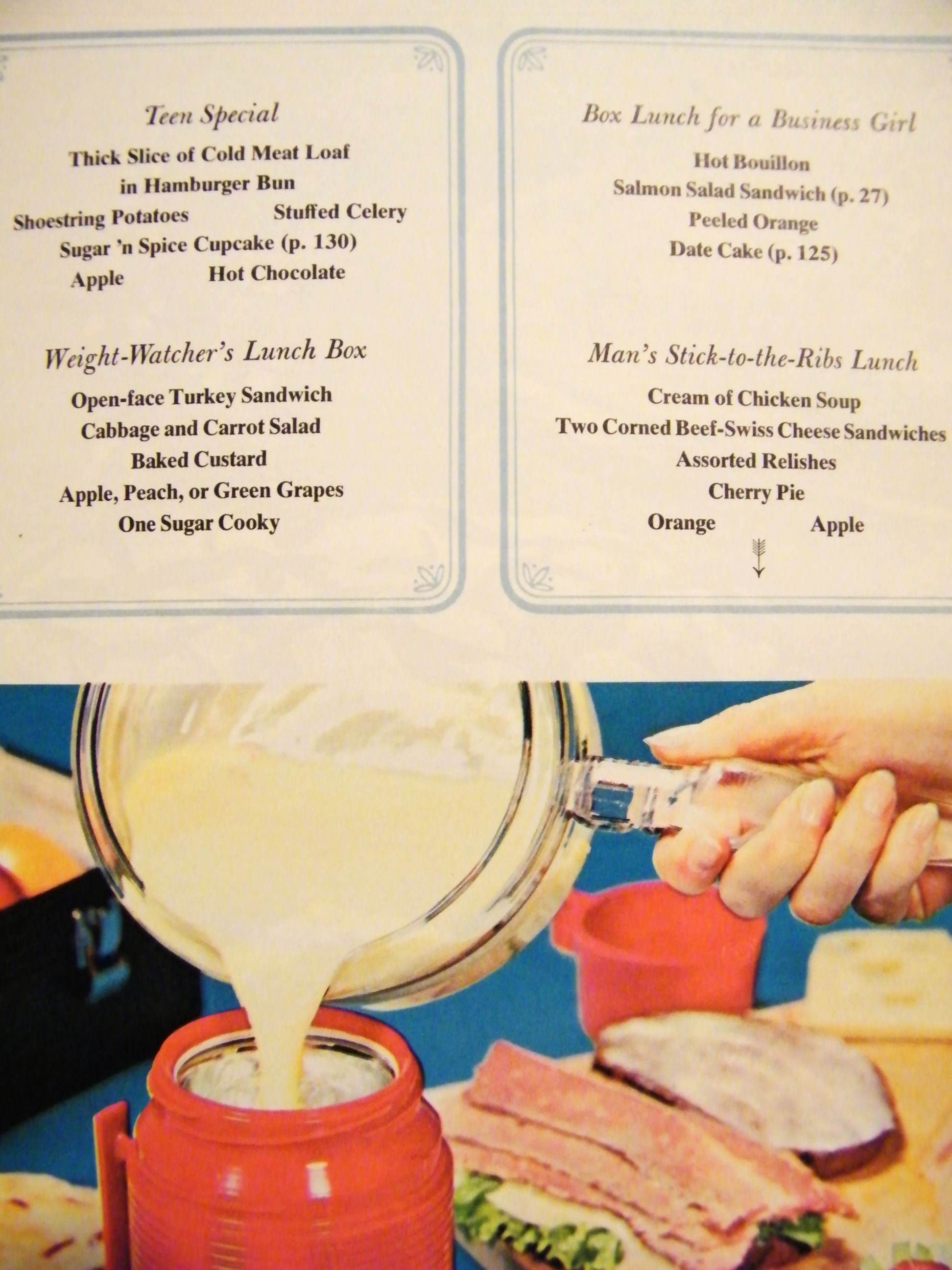
I’m going to leave you with a shot of one of my favourite pages from my Betty Crocker cookbook. (I found two copies at a library book sale years ago, bought them both and gave one to my sister.) It shows lunch suggestions for various family members and it reminds me that we live in a very different era from the one in which that book was created. Thank goodness we have Dorie to update home cookery for us today.

You can find many other blogged descriptions of this week’s FFWD recipe here: Savoury Cheese and Chive Bread